

All men's misfortunes spring from their hatred of being alone.
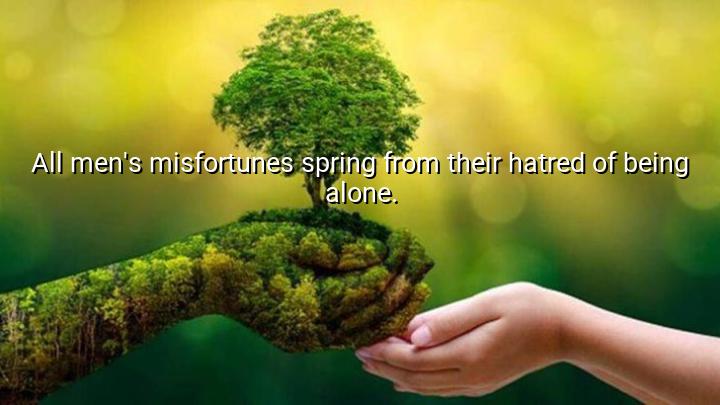




The quote "All men's misfortunes spring from their hatred of being alone" by Jean de la Bruyère explores the idea that many of the problems people face arise from their inability to accept or embrace solitude. Rather than being at peace with themselves, people often seek distraction, constant company, or external validation, which can lead to poor decisions, unhealthy relationships, and inner turmoil. De la Bruyère suggests that much of human suffering comes from avoiding the quiet, introspective moments that solitude offers.
Jean de la Bruyère, a 17th-century French moralist and essayist, is best known for his work Les Caractères, in which he offers sharp observations on human nature, society, and behavior. Deeply influenced by classical thought, including the writings of Pascal and other philosophers, de la Bruyère was interested in the psychological causes behind human actions. This quote reflects his belief that the inability to enjoy one's own company is not just a minor flaw—it can be the root of many greater misfortunes.
The “hatred of being alone” speaks to a fear of self-confrontation. When people avoid solitude, they often do so because they are uncomfortable with their own thoughts, emotions, or sense of identity. This avoidance can lead to escapism, unhealthy attachments, or the pursuit of superficial pleasures that ultimately bring more harm than happiness. According to de la Bruyère, solitude, when embraced, can be a space of growth, clarity, and inner strength.
Ultimately, the quote serves as a warning and an invitation. It challenges us to examine our discomfort with being alone and consider what that reveals about our inner lives. Instead of fleeing solitude, de la Bruyère encourages us to find wisdom in it—because only when we are comfortable with ourselves can we make choices that lead to true peace and fulfillment.

YNDao Yen Nhi
Interesting take. If we look at it from a philosophical or even spiritual lens, could the hatred of being alone be a refusal to face oneself? Maybe it’s not the absence of others that we fear, but the presence of our unfiltered thoughts. In that case, solitude becomes a mirror — and many of us don’t like what we see. Do you think learning to enjoy solitude is essential for personal growth?
PHNguyen Phuc Hanh
This quote makes me reflect on relationships — especially toxic ones. How many people stay in unhealthy dynamics because the alternative is being alone? I think it hits at something very real: we often settle, compromise, or even hurt others just to fill the silence. But why do we demonize solitude so much? Could society do a better job at teaching people that being alone doesn't mean being lonely?
KNAnh Kiet Nguyen
As someone who enjoys solitude, I’m conflicted by this quote. It generalizes a bit too much for me. Sure, loneliness can lead to some regrettable choices, but can we really say all misfortunes come from this one cause? What about greed, ignorance, or external forces beyond our control? I think there’s value in examining this idea, but it might oversimplify a very complex emotional landscape.
THBui Thi Huong-8a1
Do you think our modern obsession with staying busy — constantly scrolling, bingeing, or networking — is a symptom of this fear of solitude? This quote makes me wonder how much of our anxiety and restlessness stems from simply avoiding silence. I’m curious: has technology deepened our aversion to being alone, or has it just exposed a discomfort that was always there?
TALe Tuan Anh
I find this quote both poetic and a bit depressing. It implies that the inability to be alone is at the core of human suffering. But isn’t it also true that we’re wired for connection? Maybe the issue isn’t the hatred of being alone, but not knowing how to be alone well. Can solitude be taught or practiced like a skill — something that, if cultivated, could lead to greater peace?