

All conservatism is based upon the idea that if you leave things alone you leave them as they are. But you do not. If you leave a thing alone you leave it to a torrent of change.
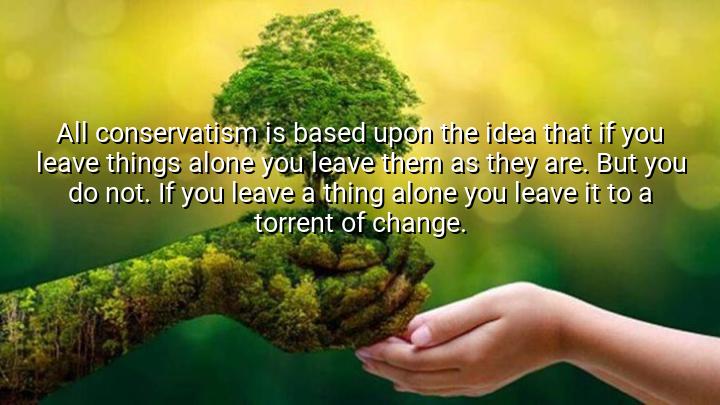




The quote "All conservatism is based upon the idea that if you leave things alone you leave them as they are. But you do not. If you leave a thing alone you leave it to a torrent of change." by Gilbert K. Chesterton challenges the fundamental idea behind conservatism, which often advocates for maintaining the status quo by leaving things alone. Chesterton argues that this approach does not preserve things as they are but, in fact, allows them to change in unpredictable and often uncontrollable ways. Inaction or choosing not to intervene can lead to unintended consequences, as everything is subject to the forces of change over time.
Chesterton’s statement also reflects his belief in the inevitability of change. Even if one aims to preserve something, the natural course of events and developments will shape it in ways that cannot be avoided. The idea of leaving things alone assumes that stability is possible, but Chesterton suggests that passivity in the face of inevitable change only accelerates the transformation. He implies that actively managing change, rather than resisting it, is the wiser course of action.
The quote critiques the conservative belief that inaction can preserve stability and suggests that true preservation requires proactive engagement with the forces of change. Rather than attempting to freeze the status quo, Chesterton advocates for a more dynamic approach to tradition and societal progress, one that acknowledges and adapts to the changing world rather than resisting it.
The origin of this quote lies in Gilbert K. Chesterton, an English writer, philosopher, and critic known for his wit and insightful commentary on politics, society, and culture. Chesterton often critiqued the limitations of both conservatism and liberalism, arguing for a middle path that embraced tradition while also acknowledging the necessity of change. This quote encapsulates his broader philosophy that true stability comes from understanding and engaging with change rather than pretending it can be avoided.

QHNguyen Quang Hung
Chesterton’s words remind me that passivity isn’t neutral—it can lead to erosion or transformation. How do individuals or societies decide when to intervene and when to let change happen? Are there risks in trying to control every aspect of tradition or progress? This quote opens up a nuanced discussion about change management.
NQDat Nguyen Quoc
This statement makes me think about how systems, whether social or natural, evolve over time. Is it possible that what we see as ‘leaving things alone’ actually allows underlying forces to reshape the landscape? How might this inform approaches to governance, conservation, or community building? It challenges simplistic views of preservation.
NNNo name
I find Chesterton’s perspective provocative because it suggests that even inaction is a form of action with consequences. How does this view affect debates about policy-making or cultural preservation? Can ‘leaving things alone’ sometimes be a strategic choice, or is it always risky? This quote invites reflection on the dynamics between change and stability.
VLLien Vy Lam
This quote highlights the paradox that neglect can lead to change, often unpredictable or undesirable. How do we balance the desire to conserve with the inevitability of change? Does this suggest that true conservatism requires proactive stewardship rather than mere inaction? It raises questions about responsibility and engagement in preserving what we value.
NNNguyen Ngao
Chesterton’s idea challenges the common notion of conservatism as simply preserving the status quo. It makes me wonder how ‘leaving things alone’ can sometimes accelerate change rather than prevent it. Does this mean active effort is required to maintain traditions? I’d be interested in exploring how this concept applies to social, political, or environmental contexts where passivity might have unintended consequences.