

The true object of all human life is play. Earth is a task garden; heaven is a playground.
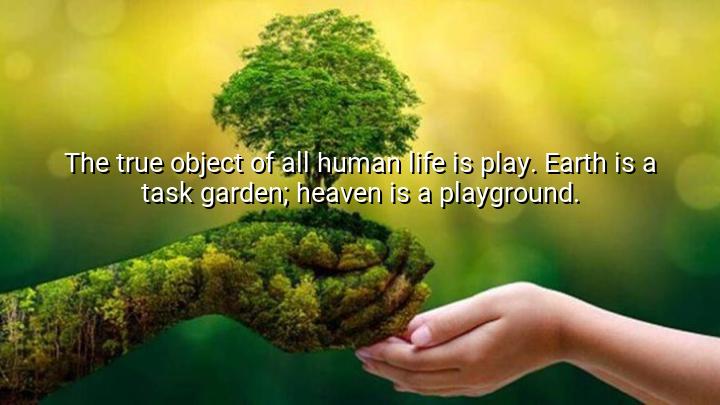




In this quote, Gilbert K. Chesterton presents a thought-provoking view of human life, suggesting that its ultimate purpose is play. He contrasts the idea of life on Earth with the notion of heaven, where the former is a “task garden”—a place of work, effort, and responsibility—while the latter is a “playground,” a realm of joy, freedom, and creativity. Chesterton’s perspective implies that while earthly existence involves struggles and duties, the ultimate goal is to approach life with a sense of lightheartedness and playfulness.
Chesterton’s use of the word "play" here doesn’t necessarily refer to literal games or frivolous activities, but to the deeper idea of embracing life with a spirit of adventure, imagination, and curiosity. He suggests that the true essence of life is not found in the grind of daily responsibilities, but in the ability to engage with the world in a playful, joyous way, much like children at play. This view encourages a balance between fulfilling one's obligations and maintaining a sense of wonder and spontaneity.
The origin of the quote can be traced to Chesterton’s broader philosophy, where he often sought to challenge conventional ideas about society, morality, and the human experience. Known for his wit and insight, Chesterton believed in the importance of seeing the world through a lens of imagination and freedom, even in the face of life’s difficulties. His works, such as Orthodoxy and Heretics, delve into these themes, urging people to find a deeper meaning in life by embracing a more playful, creative approach to existence.
In essence, Chesterton is inviting us to reconsider how we view our purpose. Instead of focusing solely on the burdens of responsibility and task-oriented living, he suggests that we should also nurture the playful, creative, and joyful aspects of our being, which reflect the true potential of human life. Play, in this context, becomes not just an escape, but a way of fully engaging with and experiencing life.

AAdministratorAdministrator
Welcome, honored guests. Please leave a comment, we will respond soon