

A man is born alone and dies alone; and he experiences the good and bad consequences of his karma alone; and he goes alone to hell or the Supreme abode.
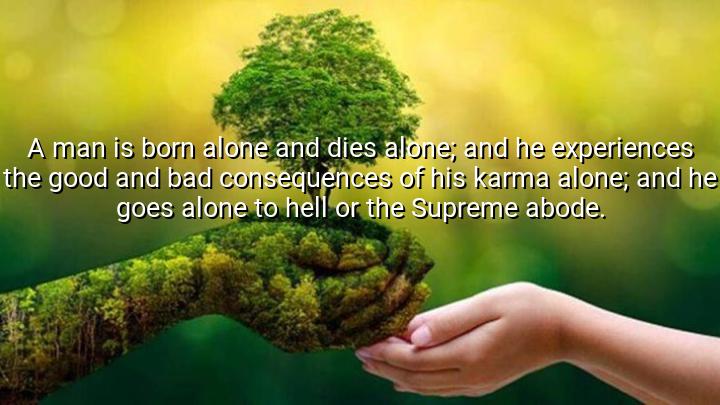




Chanakya’s quote, "A man is born alone and dies alone; and he experiences the good and bad consequences of his karma alone; and he goes alone to hell or the Supreme abode," emphasizes the individual nature of life, death, and the consequences of one’s actions. At its core, the quote speaks to the solitude of human existence, suggesting that, despite relationships and external connections, each person ultimately faces the consequences of their own actions and decisions independently. This reflects a key tenet of karma, the belief that every action has a consequence, and that individuals must experience the outcomes of their own deeds.
The quote also highlights the inevitability of death and the personal responsibility that accompanies life. While we may share moments and experiences with others, the journey of life and death is ultimately a solitary one. Chanakya points out that whether the consequences are good or bad, they are experienced alone. This aligns with his philosophical view on self-reliance and the importance of personal accountability in shaping one’s destiny.
In reference to the afterlife, Chanakya suggests that a person’s soul goes alone to either hell or the Supreme abode (often associated with moksha or liberation in Hindu philosophy), depending on the deeds performed during their lifetime. This part of the quote stresses the idea that the afterlife is a direct consequence of one’s actions and is not shared with others. It further emphasizes the individual nature of one's spiritual journey.
Ultimately, Chanakya’s quote serves as a reminder of the impermanence and solitude inherent in life. It stresses the importance of taking responsibility for one's actions, as they ultimately determine not only one’s earthly experiences but also their spiritual fate. It encourages self-reflection and mindfulness in one's actions, as we alone are the architects of our destiny.

CTTran Thi Cam Tien
It’s a sobering reminder of the solitary nature of existence. But does this perspective risk making us emotionally distant or overly individualistic? I agree that we’re accountable for our actions, but isn’t part of growth also shaped by those around us? Can this view coexist with compassion and interdependence, or does it inherently lean toward detachment and renunciation?
DMDuyen My
This quote challenges my understanding of karma and destiny. If every consequence is borne alone, does that mean even shared experiences or group actions ultimately resolve at the individual soul level? It raises a tough question: can anyone truly help or harm us beyond the karmic balance we’ve already set into motion for ourselves?
Gghgyugy
Chanakya’s words are haunting. They seem to emphasize that life is a solo spiritual path no matter how much noise surrounds us. But I wonder, is this philosophy meant to inspire detachment, or is it more about embracing self-awareness? In a world where we’re constantly looking outward for validation, this feels like a push inward—to take ownership of our fate.
TGTo Thi Giang
There’s a stark truth in this quote that’s hard to ignore. It forces me to think about personal responsibility in a deeply existential way. But it also makes me question—if we're ultimately alone in birth, death, and karma, does that diminish the value of human connection? Or does it make our relationships more meaningful, knowing they’re transient companions on an individual journey?
NNNgan Nguyen
This quote hits hard—it feels both empowering and isolating at the same time. It makes me wonder: does this emphasis on solitude and personal karma mean that relationships and community have no role in shaping our destiny? Or is it simply a reminder that, no matter who we walk beside, our final reckoning is always ours alone? It’s a sobering thought about accountability and the limits of companionship.