

Your most precious, valued possessions and your greatest powers are invisible and intangible. No one can take them. You, and you alone, can give them. You will receive abundance for your giving.
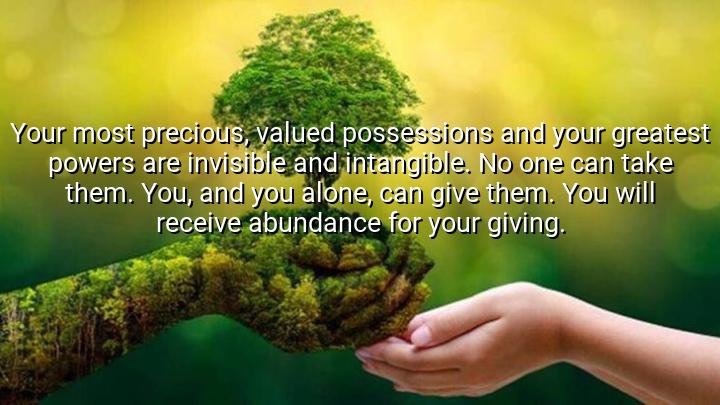




The quote "Your most precious, valued possessions and your greatest powers are invisible and intangible. No one can take them. You, and you alone, can give them. You will receive abundance for your giving" is from W. Clement Stone, an American businessman, philanthropist, and author, best known for his work in personal development and for founding the Combined Insurance Company. In this statement, Stone reflects on the invisible and intangible qualities that hold the most value in life, such as love, kindness, compassion, and wisdom. These are not physical possessions, but they can have a profound impact on one's life and the lives of others.
Stone emphasizes that unlike material wealth, these immaterial possessions cannot be taken away by anyone. They are self-generated and reside within the individual, meaning that only the person who possesses them can choose to give them. This idea suggests that the power and influence of such qualities lie in their ability to be shared with others freely, without fear of losing them.
The quote also stresses that by giving these intangible gifts—whether it's encouragement, wisdom, or emotional support—one will receive abundance in return. Stone suggests that generosity and selflessness are not just noble acts, but they also lead to personal fulfillment and growth. By contributing to others' well-being, individuals often find that they, too, receive positive returns in their own lives, whether through joy, peace, or connections.
In essence, Stone’s quote reminds us that the most meaningful aspects of life are not things that can be bought or owned, but rather qualities that come from within. These gifts, when shared, create a cycle of giving and receiving that enriches both the giver and the receiver. True wealth comes not from possessions, but from the power of giving and the abundance that flows from it.

HLvan hoe lo
Reading this quote, I’m struck by how it flips the idea of wealth on its head. It redefines abundance not as accumulation, but as generosity. Still, I’m curious—how do we cultivate this mindset in environments that reward competition and scarcity thinking? Is this kind of abundance only truly possible within communities that collectively embrace giving as a source of strength?
GTThanh Giang Tran
The idea that we alone control our greatest powers feels empowering, especially in uncertain times. But I wonder—how do we teach children or young adults to recognize and nurture those intangible strengths? If they’re invisible, do they risk being undervalued or underdeveloped in a society so focused on performance, grades, or appearance?
CLChinhs La
There’s something really hopeful in the idea that giving leads to abundance, especially in an era of transactional relationships. But I can’t help but question: is there a risk in over-giving? What protects us from burnout when we constantly share our intangible assets—like emotional energy, love, or attention—without boundaries? Should this philosophy come with a cautionary balance?
NTNgoc Tram
This quote makes me think about how generosity and self-worth are so interconnected. It suggests we have control over the most valuable parts of ourselves, which is a comforting thought. But I wonder, can life’s traumas or hardships weaken those internal treasures, even if no one ‘takes’ them? What happens when we feel we’ve lost connection to our inner resources?
NNBui Ngoc Nhien
I love the message here—it’s empowering to think that our greatest strengths can’t be taken, only shared. But I also question: what happens when we give generously and don't see that promised ‘abundance’ in return? Is the reward always tangible, or does it come in unexpected, spiritual, or emotional ways that we have to train ourselves to recognize?