

You need a whole community to raise a child. I have raised two children, alone.
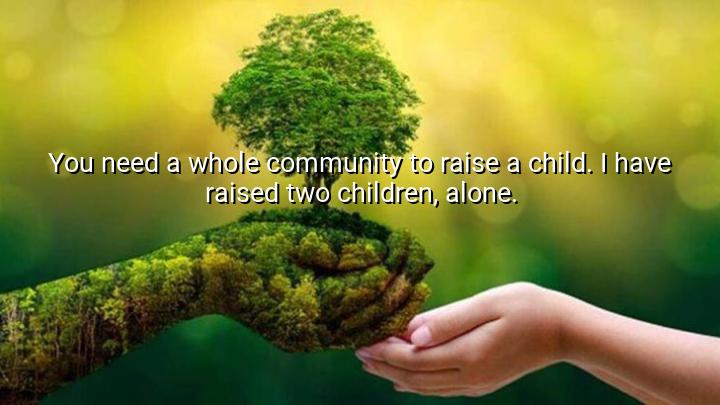




The quote, "You need a whole community to raise a child. I have raised two children, alone," is from the acclaimed American author Toni Morrison. In this powerful statement, Morrison reflects on the idea that parenting and the well-being of a child should not rest solely on one individual. It emphasizes the importance of a supportive community in the nurturing and development of children, highlighting that it takes more than just one person to provide the care, guidance, and love necessary for a child to grow.
Morrison’s use of the word "community" signifies that a child’s upbringing is deeply influenced by the broader social environment, including family, friends, teachers, and society at large. The quote implies that cooperation and shared responsibility within the community are essential to ensure a child's overall well-being and success. It stresses that village-like support, rather than isolation, is crucial for healthy development.
At the same time, Morrison reveals a personal vulnerability by adding, "I have raised two children, alone." This acknowledgment speaks to the challenges of single parenthood, where the individual often carries the full burden of raising children without the support of a larger community. Morrison's words convey both a sense of strength and resilience in facing these challenges, but also a recognition of the difficulties involved in raising children without collective support.
Ultimately, this quote highlights Morrison’s broader themes of community, support, and shared human experience. It calls attention to the importance of social responsibility and the profound impact of community involvement on a child's upbringing, while also honoring the personal sacrifices made by those who parent alone.

HAHihi A
This statement opens a conversation about redefining ‘community’ in contemporary times. Is the ‘whole community’ always geographical, or can it include virtual, chosen, or support groups? How might technology and social media change the way parents find support? Can new forms of community fill the gaps for those raising children alone?
NLnha linh
Emotionally, this quote feels both vulnerable and defiant. It acknowledges an ideal but also confronts the reality of raising children alone. How might this honesty encourage others in similar situations to share their stories? Could recognizing these challenges lead to more empathy and practical help for solo parents in communities?
MNThai Minh Ngo
Reading this, I wonder about the cultural variations in child-rearing practices. In what ways do different societies embody or fall short of the ideal of communal parenting? Could modern urbanization and mobility be eroding traditional community roles? How do single parents adapt in environments where extended support networks are diminishing?
GVNgan Giang Vo
I’m struck by the quiet strength in Morrison’s admission. How might her experience influence her views on family, community, and responsibility? Does this reflect a broader issue where many parents feel isolated despite societal emphasis on collective child-rearing? How important is it for public policies to acknowledge and address the realities of solo parenting?
NQDai Nguyen Quoc
This quote makes me think about the gaps in social support for single parents. If ideally a whole community raises a child, what happens when that community is absent or fragmented? How can society better support parents who are raising children alone, whether due to choice or circumstance? It also raises questions about the resilience and strength required in solo parenting.