

You must learn to exist with no religion, no country, no allies. You must learn to live alone in silence.
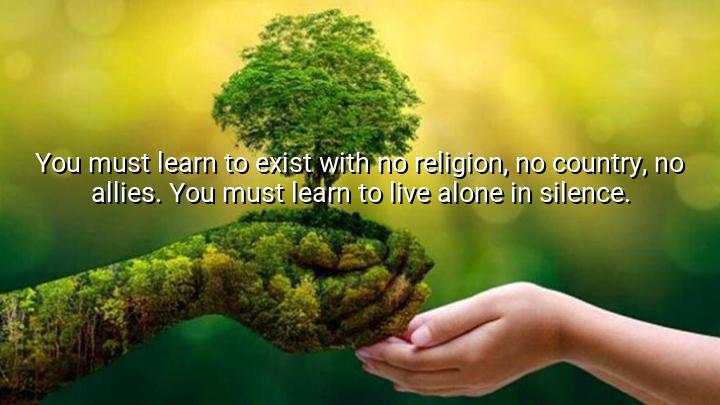




The quote "You must learn to exist with no religion, no country, no allies. You must learn to live alone in silence." by William S. Burroughs conveys a message about independence and self-reliance in the face of modern societal structures. Burroughs, a groundbreaking American writer and a key figure in the Beat Generation, often explored themes of alienation and the rejection of conventional norms. In this statement, he advocates for detachment from societal institutions like religion, nationality, and even alliances, suggesting that true freedom comes from being self-sufficient and emotionally detached from the structures that typically define one’s identity.
Burroughs' call to "live alone in silence" reflects a deeper philosophical stance that emphasizes personal autonomy and the need to find peace within oneself, rather than relying on external sources for meaning or validation. This can be interpreted as a rejection of external dependencies and a challenge to embrace solitude and introspection as ways to reach a truer sense of self. The idea of living alone in silence suggests not a life of isolation, but rather a life of clarity and self-awareness that comes from minimizing distractions and societal pressures.
This quote also reflects Burroughs’ broader literary themes, where he often critiqued the constraints placed on individuals by societal structures and advocated for the breaking of these constraints to explore more authentic ways of being. His work frequently explored the consequences of conformity and how the structures of power and control can distort human experience. Here, he implies that true understanding and freedom come when one sheds the identities imposed by culture, religion, and politics.
Ultimately, Burroughs’ words challenge the listener to find inner peace and strength by stepping away from the noise and the norms of the outside world. It’s an invitation to reclaim individual sovereignty by learning to live authentically and independently, free from the expectations and influences of society. His emphasis on silence and solitude suggests that clarity and personal growth come from within, when one is unburdened by external allegiances or identities.

VHvu hoang
This quote makes me think about the broader cultural context in which Burroughs wrote—perhaps a reaction to societal constraints and identity politics. Is this an expression of rebellion against imposed identities, or a deeper philosophical meditation on existence? It challenges readers to reflect on what truly defines them beyond external affiliations.
MTMan Truong
I’m curious about the psychological and emotional implications of living completely without ‘religion, country, or allies.’ How does one maintain hope, meaning, or resilience in such a state? Does this reflect a profound existential crisis or a liberating detachment? This statement opens up a dialogue about the balance between independence and support systems.
MLLe Ngoc My Lu
Could this be interpreted as a call to strip away external labels and dependencies to find one’s true self? If so, how practical is this advice in today’s interconnected world? I wonder whether Burroughs sees this as an achievable ideal or a necessary existential challenge. This quote invites a discussion on the tension between individuality and social belonging.
LXLynn xinhgai:3
This quote makes me question the role of silence and solitude in personal growth. Could learning to live ‘alone in silence’ be a path to deeper self-awareness and authenticity? Or does it risk fostering loneliness and despair? It’s a provocative idea that challenges the conventional wisdom about the value of relationships and cultural ties.
NLLe Thi Nhat Ly
I’m intrigued by the idea of ‘existing with no religion, no country, no allies.’ Is Burroughs suggesting freedom through detachment, or is this a cautionary observation about losing those anchors? It raises complex questions about belonging, purpose, and isolation. How does one reconcile the desire for independence with the innate need for community and connection?