

You may not enjoy loneliness, because loneliness is sad. But solitude is something else; solitude is what you look forward to when you want to be alone, when you want to be with yourself. So, solitude is something we all need from time to time.
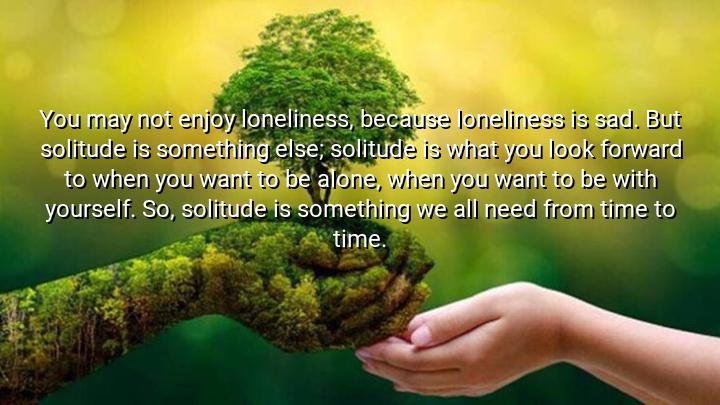




In this quote, Ruskin Bond, an Indian author known for his writings on nature and the human experience, draws a clear distinction between loneliness and solitude. He acknowledges that loneliness is often perceived as a sad and unwanted feeling, a state where one feels isolated and disconnected from others. In contrast, he describes solitude as a positive and sought-after experience, where an individual chooses to be alone in order to reconnect with themselves. Bond suggests that solitude is not something that comes from a lack of connection, but rather from a conscious desire for personal reflection and peace.
Bond emphasizes that solitude is essential for personal growth and well-being. It is a time when one can enjoy their own company, focus on self-reflection, and engage in activities that bring inner peace. Unlike loneliness, which can be associated with a sense of emptiness or sadness, solitude allows for mental clarity and a sense of being in tune with oneself. For Bond, solitude is not about escape but about embracing quiet moments for personal rejuvenation.
The quote reflects Bond's belief in the importance of having time alone, not as a burden but as a necessary part of human life. He suggests that everyone needs moments of solitude to recharge, clear their minds, and engage in introspection. Solitude, in his view, provides a space for people to reconnect with their true selves, away from the noise and distractions of the world.
Ultimately, Bond’s statement encourages us to reframe our view of being alone. Instead of seeing it as something negative, he highlights the value of solitude as a time for growth, reflection, and personal space. By making time for solitude, we can nurture our well-being and find peace within ourselves, allowing us to return to the world with renewed clarity and purpose.

HGHa Thi Huong Giang
This quote gently reminds me that solitude can be something to look forward to, not avoid. But I wonder, how do we protect that solitude in a hyper-connected world where we’re always online, always reachable? Even when I’m physically alone, I don’t always feel mentally or emotionally disconnected. Can we truly experience solitude if our minds are still tethered to the noise of the outside world?
PPLe Phong Phu
I love the distinction this quote makes, but it makes me think—do we all have the luxury to experience solitude? For someone in a loud household, a demanding job, or constantly surrounded by people, finding time alone might be almost impossible. How do we create space for solitude in lives that are overcrowded and overstimulated? Is carving out solitude a privilege or a necessity?
TVHo huynh tuong van
This quote brings up an interesting question: can solitude be learned or cultivated? For some, being alone feels freeing, but for others, it's uncomfortable—even scary. Is it possible to train ourselves to enjoy solitude, just like we build other habits? I'd be curious to know if people who fear being alone can eventually find peace in it, or if solitude is more of a natural preference.
BHLan Bui Huong
I resonate with this so much. There are days when I crave solitude, but then I worry that people might see it as me being anti-social or distant. Why do we judge people who seek space and silence, especially when it's often healthy and restorative? Should we be doing more as a culture to validate solitude as a form of self-care rather than a symptom of withdrawal?
XVXinh Vu
This quote really helped me understand the difference between being lonely and being alone. It makes me wonder—why do we so often confuse the two? Is it because society equates solitude with sadness, or because we fear what might surface when we’re left with only ourselves? I’d love to hear how others have learned to embrace solitude without falling into loneliness. Is it a mindset, or something deeper?