

You can't walk alone. Many have given the illusion, but none have really walked alone. Man is not made that way. Each man is bedded in his people, their history, their culture, and their values.
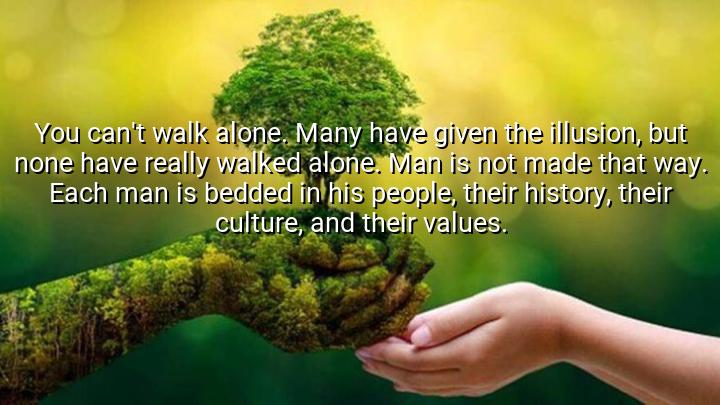




The quote "You can't walk alone. Many have given the illusion, but none have really walked alone. Man is not made that way. Each man is bedded in his people, their history, their culture, and their values." by Peter Abrahams emphasizes the interconnectedness of human beings and the idea that no one can truly exist in isolation. Abrahams, a South African writer and activist, highlights the influence of society, culture, and community in shaping an individual’s identity and experience. While some may perceive themselves as independent or self-reliant, the truth is that every person is deeply rooted in their heritage and the values passed down by their people.
Abrahams argues that the notion of walking through life alone is an illusion, as every individual is shaped by the history and traditions of the community they belong to. Whether consciously or unconsciously, our values, beliefs, and actions are influenced by the collective experience of those who came before us. The quote underscores the importance of understanding that individual identity is always intertwined with cultural and social contexts.
The statement also addresses the idea that no one is completely self-made. Even when people appear to achieve success or make decisions on their own, they are inevitably influenced by the social fabric in which they are embedded. Family, education, and community play crucial roles in guiding and shaping one’s worldview. Abrahams highlights that the support and shared experiences from others are fundamental to personal development and achievement.
Ultimately, Abrahams’ words remind us that human beings are social creatures, whose lives are shaped by their relationships with others. The quote encourages a deeper appreciation for the influence of culture, history, and society on an individual’s journey, recognizing that we are never truly alone as we walk through life.

TNNguyen Thanh Nam
Abrahams touches on something timeless here—the human need for connection, not just in the present but through history and ancestry. But in an increasingly globalized and digital world, are we at risk of losing touch with that grounding? How do we maintain a sense of being ‘bedded’ in community and culture when modern life often encourages disconnection, relocation, and reinvention?
TTDinh thi thanh thao
This quote has a quiet strength to it. In a way, it reminds me that even when we feel alone, we are carrying generations within us. But does recognizing that interconnectedness empower us or burden us? Sometimes I struggle with inherited expectations or cultural values that don’t align with who I am. How do we honor our roots while also claiming our personal truth?
TBHoang Thanh Binh
I love how this quote dismantles the myth of total independence. But it also makes me wonder—what happens when someone feels disconnected from their roots, or alienated from their culture or family? Can they still find identity and belonging, or is that sense of being ‘bedded’ something that can only be inherited and not built from scratch? That feels like a deep existential question.
HTHanh thuy
This quote makes me reflect on how much of my choices are really my own. If we’re all ‘bedded’ in our people and culture, to what extent can we claim individuality? Is identity a negotiation between self and society, or is the very idea of a self without context just an illusion? I think Abrahams is gently pushing us to acknowledge the collective nature of our journeys.
MCmei clz
I find this quote incredibly grounding. It challenges the romanticized idea of the lone hero forging their own path. But I’m curious—if no one truly walks alone, how much responsibility do we bear for honoring the traditions and values we inherit? Can we ever truly break free from our cultural imprint, or are we simply modifying the framework passed down to us?