

You cannot be lonely if you like the person you're alone with.
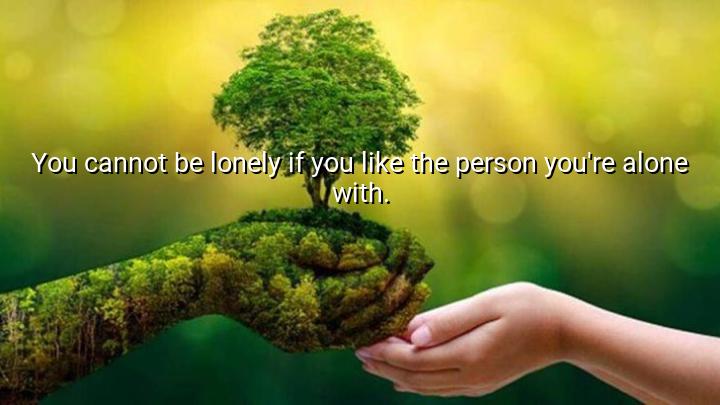




The quote "You cannot be lonely if you like the person you're alone with" by Wayne Dyer highlights the connection between self-acceptance and emotional well-being. Dyer suggests that loneliness is not simply about being without others, but about how we feel about ourselves when we are alone. If we have a positive relationship with ourselves, then solitude becomes a space of peace, not of pain.
Wayne Dyer, a renowned self-help author and motivational speaker, often focused on themes like self-love, inner peace, and the power of mindset. This quote reflects his belief that much of our happiness depends on our internal world, not external circumstances. When we truly enjoy our own company, we no longer fear being alone because we are not trying to escape ourselves—we are embracing who we are.
The quote also challenges a common assumption that being alone equals being lonely. Dyer reframes solitude as a potential gift, especially for those who have cultivated self-respect, self-understanding, and emotional independence. If you like yourself, then being alone can be refreshing, fulfilling, and even joyful.
Ultimately, Dyer’s message is a call to nurture self-love. By becoming someone we enjoy spending time with, we reduce our reliance on others for validation or happiness. In doing so, we transform solitude into a space of growth, confidence, and freedom.

NNNguyetccc Nguyetccc
There’s a hopeful energy in this quote that I really appreciate. It suggests that loneliness isn’t about being physically alone but about emotional disconnection from yourself. But how do we measure 'liking' ourselves? Is it about self-confidence, compassion, or simply acceptance? And is that something that stays constant, or does it ebb and flow depending on our mental and emotional state? I’d love to explore that further.
TANgoc Do Thi Anh
Dyer’s quote sounds empowering, but I can’t help wondering—what if someone has experienced trauma or rejection and hasn't yet rebuilt a sense of self-worth? Can they still find peace in being alone? It seems like this quote assumes a baseline of self-esteem that not everyone has. So maybe the better question is: how do you start liking the person you're alone with if you never learned how to appreciate yourself in the first place?
TDDuy Tran Duc
This quote feels like a gentle reminder of something we often forget—that self-acceptance is the root of emotional stability. But what happens if you’re still learning to like yourself? Is loneliness then inevitable until you’ve done all the inner work? I’d love to hear how people bridge that gap, moving from discomfort with themselves to a place where solitude becomes something to embrace rather than endure.
AHAnh Hong
I love the simplicity of this quote, but I also think it's deceptively complex. It makes me question: does liking yourself mean you're truly shielded from loneliness, or are there still moments when you crave connection, even if you’re self-assured? I’ve found that solitude can be fulfilling, but that doesn’t always mean I don’t feel lonely. Is it possible to feel both at the same time?
TDNguyen The Dung
This quote really speaks to the idea of self-love, but it also makes me wonder—how many people actually enjoy their own company? If you don’t like who you are, does solitude automatically become suffering? That’s a painful truth for some. So, how do we build a better relationship with ourselves so that being alone becomes peaceful instead of painful? I think this quote points to a deep emotional skill we don’t always learn early on.