

You can make people feel valued or cared for by design alone. It's not purely about money. It's about how we choose to value human experience.
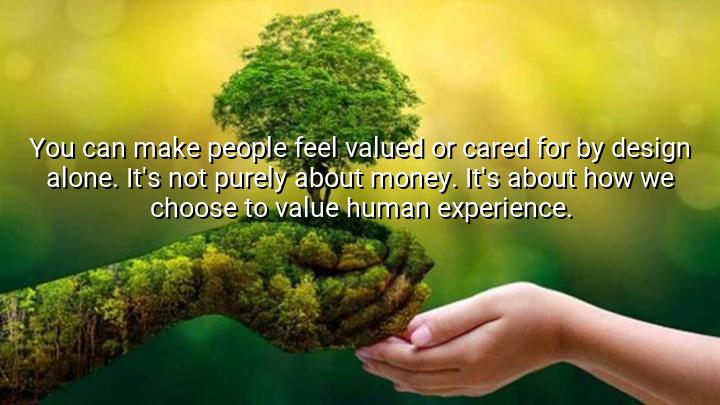




The quote "You can make people feel valued or cared for by design alone. It's not purely about money. It's about how we choose to value human experience" by Thomas Heatherwick emphasizes the idea that design plays a crucial role in how people feel in a given space or experience. Heatherwick suggests that it is not just material wealth or financial investment that determines how valued people feel; rather, it is the intentionality and thoughtfulness behind design choices that convey care, respect, and human value. Whether it’s a building, a product, or a public space, design has the power to communicate empathy and consideration for human needs.
Heatherwick’s statement challenges the notion that value is purely monetary. He highlights the importance of experience and how design can shape that experience. For example, well-designed spaces can foster a sense of belonging or comfort, while poorly designed spaces may create feelings of neglect or alienation. This reflects his belief that design should prioritize the human experience over profit-driven motives, aiming to create environments where people feel cared for, seen, and respected.
This quote also speaks to the broader philosophy of design as a tool for social impact. Heatherwick suggests that design can influence how individuals interact with the world and each other, thereby affecting their overall well-being. By carefully considering how people use and experience spaces, designers can create environments that improve quality of life and foster a sense of community.
The origin of this quote stems from Thomas Heatherwick’s work as a renowned British designer, known for his innovative approach to architecture and industrial design. His projects often aim to blend aesthetics with functionality, creating spaces and objects that consider the emotional and psychological needs of users. His philosophy reflects a deep commitment to enhancing human experience through thoughtful design choices.

PTPhuong TG
The idea that design can communicate care without financial investment is inspiring. How can communities with limited resources leverage design thinking to improve quality of life? Does this perspective encourage more sustainable and equitable design practices? I’d be keen to discuss innovative projects that prioritize human experience as a core value in design.
N120. Thanh Nhu 11A1
This quote makes me consider how design extends beyond physical objects to systems and services. How can service design make people feel valued in contexts like education, transportation, or customer service? Does this imply that every interaction is an opportunity to demonstrate care through thoughtful design? I’m interested in how this approach affects trust and loyalty.
TTTien Thuy
Heatherwick’s words suggest that valuing human experience is a choice reflected in design decisions. How do organizations or governments prioritize design to express care for their communities? Are there risks that design might become superficial if not grounded in authentic concern? I’d like to explore how participatory design processes engage users in creating meaningful experiences.
KTLe Kim Thanh
Reading this, I’m struck by the power of intentional design in shaping social interactions. How does the environment influence whether people feel respected and cared for? Can small design choices make a big difference in inclusivity and accessibility? It would be interesting to discuss how design education incorporates these human-centered values and their broader societal impact.
BbeSeni
This statement challenges the assumption that money is the primary way to show care. How might design principles be applied in public spaces, workplaces, or healthcare settings to enhance well-being? Does this perspective suggest that valuing human experience is a mindset that transcends budgets? I’m curious about how designers integrate empathy and cultural sensitivity into their work to foster genuine connection.