

You are 27 or 28 right? It is very tough to live at that age. When nothing is sure. I have sympathy with you.
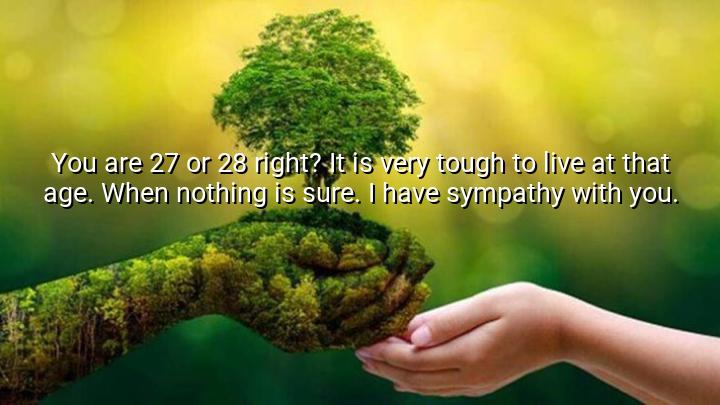




The quote, "You are 27 or 28 right? It is very tough to live at that age. When nothing is sure. I have sympathy with you," comes from the renowned Japanese author Haruki Murakami. It reflects the feelings of uncertainty and confusion that many young adults experience as they approach their late twenties. Murakami's characters often grapple with existential questions, and this quote is a perfect example of his exploration of self-doubt and the search for meaning.
At the age of 27 or 28, individuals often face a significant period of transition. Many are trying to figure out their career, relationships, and life purpose. The lack of certainty about the future can feel overwhelming, which is why Murakami refers to this age as particularly difficult. His sympathy comes from understanding that during this time, people feel like they are on the edge of adulthood but still unsure about where they fit into the larger picture of life.
This quote encapsulates a universal experience of uncertainty and change, which is why it resonates with so many people. Murakami's ability to pinpoint these emotional struggles is a hallmark of his writing, and this reflection on age 27 or 28 connects deeply with readers navigating similar phases of their own lives. It’s a moment when everything feels uncertain, and yet, it is a formative time that shapes one's future journey.

PTPhuong Thao
Murakami's sympathy feels rare and validating. Late twenties can be a lonely age because you're no longer part of youth culture, but you haven't arrived at the stability of adulthood either. You're betwixt and between. Why is this transitional phase often ignored in broader cultural narratives? We talk about teenage angst and midlife crises, but seldom address the emotional ambiguity of being 27 or 28.
NTNguyen Tien
This makes me think about how society pushes us to equate age with achievement. If you haven’t 'made it' by your late twenties, you’re seen as falling behind. Murakami gently refutes that mindset by acknowledging the difficulty. Why don’t more people, especially those in positions of influence, speak so openly about this kind of struggle? It could reduce a lot of unnecessary shame and isolation.
Cchau
I used to believe that I’d have everything figured out by 28. But Murakami’s words highlight a universal truth: we don’t. There's pressure to define yourself—professionally, emotionally, financially—yet the tools to do so are often still forming. I wonder how this tension affects our mental health and relationships. Do we internalize failure for not meeting unclear milestones by an arbitrary age?
TMPhan Tuan minh
Isn’t it strange how the world treats your late twenties as the prime of life, yet so many feel lost during that phase? Murakami’s quote beautifully cuts through the illusion of stability. I think it’s valuable that someone so revered sees the chaos of that age with sympathy rather than judgment. Should we start treating this period as a normal, even necessary, time of self-questioning and transition?
NTThu Uyen Nguyen Thi
I find this quote incredibly comforting. It acknowledges a struggle that many people experience silently. Being 27 or 28 is like standing at the crossroads of youth and adulthood, burdened with expectations but lacking clear direction. Murakami’s gentle tone almost feels like a hand on the shoulder. I wonder, though, does this uncertainty ever really go away, or does it just evolve with age?