

I know how fiction matters to me, because if I want to express myself, I have to make up a story. Some people call it imagination. To me, it's not imagination. It's just a way of watching.
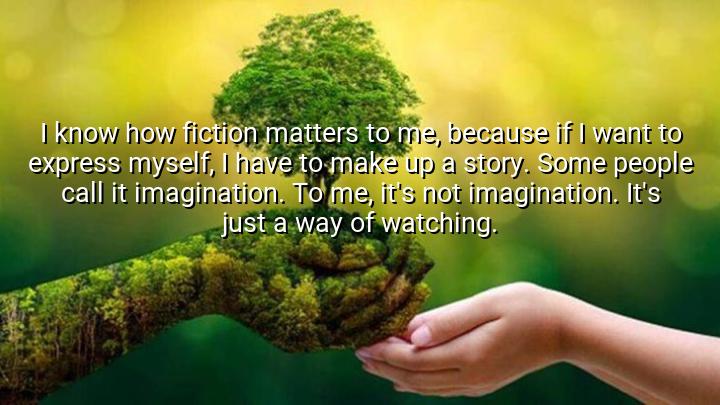




The quote "I know how fiction matters to me, because if I want to express myself, I have to make up a story. Some people call it imagination. To me, it's not imagination. It's just a way of watching" by Haruki Murakami reflects the unique way the author views the process of storytelling and creativity. For Murakami, the act of creating fiction isn't about inventing something entirely from scratch or using imagination in the conventional sense. Instead, it is a way for him to observe and understand the world, translating his observations into stories that reflect his inner experiences and perceptions.
Murakami distinguishes his process from traditional views of imagination. Rather than seeing it as a purely creative or fantastical exercise, he views storytelling as a form of observation, where he watches the world around him, absorbs details, and then filters them through the lens of fiction. In this sense, creating a story becomes a way to make sense of emotions, experiences, and the complexities of life. For Murakami, fiction is a way to engage with the world more deeply, not just a tool for escapism or fantasy.
The origin of this quote ties into Murakami's larger philosophy on writing and creativity, which often blurs the lines between reality and imagination. Known for his surreal and often introspective style, Murakami frequently explores themes of isolation, dreams, and the subconscious. This quote highlights his belief that fiction is not just an escape from the world but a way to interact with and process it. His stories are often grounded in the ordinary, yet they take on profound meanings through the lens of observation and storytelling.
Ultimately, Murakami’s quote challenges traditional ideas of imagination by framing it as a means of observation rather than creation from nothing. It suggests that storytelling is not about fabricating an entirely new world, but rather about watching life closely, interpreting it through a fictional narrative, and expressing deeper truths about human experience. By positioning fiction as a form of seeing, Murakami invites readers to think of storytelling as a way to reflect on and engage with the world in a more meaningful way.

AAdministratorAdministrator
Welcome, honored guests. Please leave a comment, we will respond soon