

Wisdom is not wisdom when it is derived from books alone.
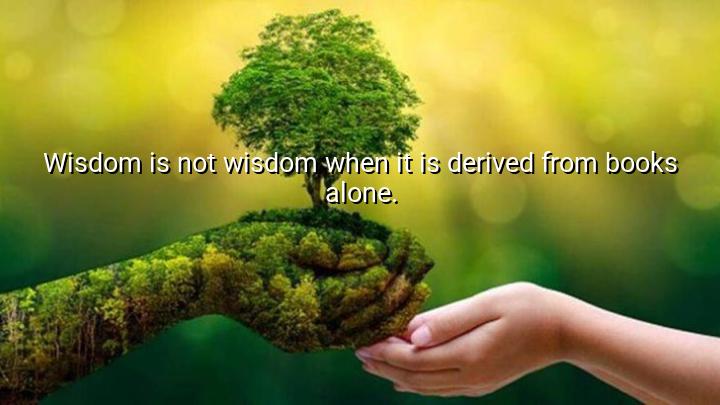




In this quote, Horace challenges the idea that wisdom can be obtained solely through books or theoretical learning. He suggests that true wisdom goes beyond simply accumulating knowledge from written texts. While books are valuable sources of information, they alone cannot provide the depth and understanding needed to attain genuine wisdom. According to Horace, wisdom is something that requires practical experience and insight, which cannot be fully captured or understood through reading alone.
Horace’s statement reflects the ancient philosophical belief that knowledge and wisdom must be integrated into one’s life through personal experiences and reflection. Experience, particularly life’s challenges and interactions with others, plays a crucial role in shaping a person’s ability to apply knowledge meaningfully. In other words, a person may learn facts from books, but without experience and the ability to reflect on those experiences, that knowledge cannot fully evolve into wisdom.
The quote also points to the limitation of book learning in understanding the complexities of the world. Wisdom, as Horace suggests, requires more than intellectual knowledge; it involves a deeper understanding of human nature, morality, and the world around us, all of which are gained through personal growth and lived experiences. This aligns with Horace's broader views on the importance of practical knowledge and wisdom gained through both intellectual and emotional development.
Ultimately, Horace’s quote serves as a reminder that true wisdom comes from the combination of book learning and life experiences. It encourages individuals to seek knowledge from various sources, but to also recognize the value of personal experience in shaping a deeper and more meaningful understanding of the world.

TDPhan Trung Dung
I find Horace’s observation humbling. It makes me reflect on my own tendency to rely on reading as a substitute for engagement with the world. Is it possible I’ve mistaken knowing about something for truly understanding it? Perhaps wisdom demands more than absorbing words—it asks us to confront failure, build empathy, and grow from discomfort. Can we ever become wise without stepping outside the pages and into life itself?
HLTran Thi Ha Linh
This line makes me question how wisdom is portrayed in modern society. We tend to celebrate intellectuals and scholars, but overlook those who gain insight through hardship, work, or personal reflection. Does our culture overvalue formal education at the expense of experiential understanding? Maybe wisdom is less about credentials and more about resilience, humility, and the ability to learn from one’s own and others’ lived stories.
NANguyen thi Ngoc anh
I appreciate this quote because it challenges the assumption that being well-read equals being wise. But I’m curious—how do we define the boundary between knowledge and wisdom? Is wisdom just applied knowledge, or is it something more intuitive, like emotional intelligence or discernment? It makes me wonder if some people accumulate facts their whole lives but never reach wisdom because they don’t reflect or grow from experience.
BTBao Tram
I completely relate to this. Some of the wisest people I know didn’t go to college or read extensively—they just lived deeply and paid attention. But I also wonder, is there a risk in undervaluing books? Literature, philosophy, and history can offer insights we might never encounter in our daily lives. So maybe the real question is: how do we blend intellectual study with experience to develop holistic wisdom?
KTKhanhbao Tran
This quote makes me think about how much of our education system still relies on passive reading and theoretical instruction. Is it really possible to be wise without lived experience? I agree with Horace that true understanding comes from applying knowledge in real-life situations. But then, how do we bridge the gap between academic learning and practical wisdom? Should experiential learning be a bigger part of formal education?