

Wisdom alone is the science of other sciences.
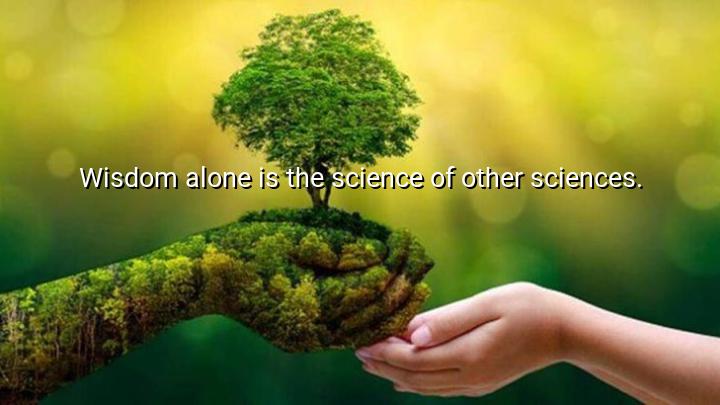




In this quote, Plato emphasizes that wisdom is the foundation upon which all other knowledge is built. He asserts that wisdom alone is the most important science because it provides the necessary insight and understanding to approach all other fields of study. Wisdom, in Plato’s view, is not just a collection of facts or skills; it is a deeper understanding of how knowledge fits together, how to apply it properly, and how to live a virtuous life.
Plato’s philosophy suggests that wisdom enables a person to navigate the complexities of life and society. While other sciences—such as mathematics, physics, or art—offer specialized knowledge, wisdom transcends these disciplines. It is the ability to discern the underlying truths behind various aspects of existence. This wisdom is not just academic; it also involves moral and ethical judgment, helping individuals apply their knowledge in a way that is both effective and beneficial to society.
By calling wisdom the "science of other sciences," Plato is reinforcing the idea that the pursuit of knowledge should always be guided by wisdom. He implies that wisdom is the ultimate tool for making sense of all other branches of learning, as it provides the perspective and discernment needed to evaluate and synthesize different forms of knowledge. Without wisdom, knowledge can become fragmented or misapplied.
Ultimately, this quote encourages the pursuit of wisdom above all else. It suggests that true understanding comes not from mastering individual subjects, but from cultivating a broader sense of insight and judgment that allows one to make sense of and integrate all areas of study and experience. Wisdom is the guiding principle that helps individuals apply their learning in ways that lead to a better, more harmonious life.

ITDatJump Into TheHole
There’s a poetic quality to this quote that makes me think about the difference between information and insight. We live in a time of abundant data, yet Plato’s words seem more relevant than ever. Is wisdom something we can measure or teach, or is it cultivated through a lifelong process of ethical inquiry, self-awareness, and lived experience? I’d love to hear how others interpret this idea in modern terms.
UGUser Google
I’m intrigued by the way this quote elevates wisdom to a kind of ultimate framework. In today’s world, where knowledge is so fragmented, could the lack of integrated wisdom be part of why we face so many global crises—climate, inequality, misuse of tech? It seems like Plato is reminding us that knowing facts isn’t enough without the guiding force of a deeper, unifying intelligence.
NDPham Ngoc Diep
Plato’s idea feels both inspiring and daunting. If wisdom encompasses the essence of all other sciences, does that mean a truly wise person understands not just facts, but also the ethical and existential implications behind them? Can someone be considered wise without being well-versed in other disciplines, or is it the synthesis and humility across fields that defines wisdom?
GDGold D.dragon
This statement makes me reflect on how rare true wisdom seems to be, even among the highly educated. Is wisdom something that comes through experience, reflection, or something more transcendent? If it underpins all sciences, why don’t we see more interdisciplinary approaches guided by ethical or philosophical insight? It feels like a call to integrate values more intentionally into scientific advancement.
TNTrinh Nhung
I find this quote profound, but also puzzling. If wisdom is the science of sciences, does that mean it’s inherently superior to technical expertise in fields like medicine, engineering, or physics? Or is Plato suggesting that without wisdom, these sciences lack moral direction? I’d love to know how we can train ourselves—and future leaders—to cultivate wisdom alongside specialized learning.