

Who knows what true loneliness is - not the conventional word but the naked terror? To the lonely themselves it wears a mask. The most miserable outcast hugs some memory or some illusion.
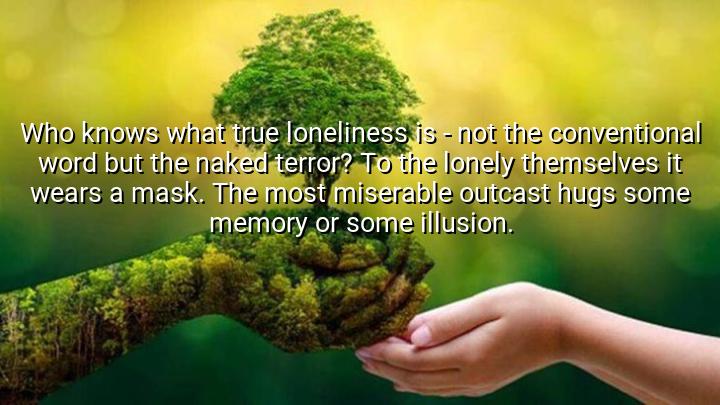




The quote "Who knows what true loneliness is - not the conventional word but the naked terror? To the lonely themselves it wears a mask. The most miserable outcast hugs some memory or some illusion" by Joseph Conrad delves into the deeper, more terrifying aspect of loneliness. Conrad distinguishes between ordinary loneliness, which is commonly understood, and the more intense, existential solitude that brings about fear and despair—the "naked terror." He suggests that true loneliness is not just the absence of others, but a more profound psychological and emotional state that can feel overwhelming and inescapable.
Joseph Conrad, a Polish-British novelist and short story writer, is known for his works such as Heart of Darkness and Lord Jim, where he often explored themes of alienation, isolation, and psychological struggle. This quote reflects Conrad’s deep understanding of the human condition, particularly the way people cope with internal suffering. His works frequently investigate the dark side of human nature, and this quote reveals his view that loneliness is not just a social condition but can be a terrifying experience that people often hide behind memories or illusions.
The phrase "it wears a mask" highlights how those who experience true loneliness may not outwardly show the extent of their pain. People often disguise their inner turmoil with deflections or false narratives, such as clinging to past memories or illusions that offer temporary comfort or meaning. Conrad suggests that these masks allow individuals to avoid confronting the full depth of their isolation and despair.
Ultimately, Conrad’s quote brings attention to the hidden nature of true loneliness and the psychological coping mechanisms people use to mask their suffering. It underscores the existential terror that can accompany profound isolation, and how individuals often cling to illusions to mask the painful reality of being alone. It serves as a reminder of how loneliness can manifest in ways that are invisible to others, often masked by memories or self-deception.

THTran Thu Hien
I’m wondering about the difference between solitude and this terrifying form of loneliness Conrad describes. Some people find great peace in being alone, while others experience it as torment. Is the key difference the presence of self-acceptance or meaning? Maybe it’s not the absence of others that defines loneliness, but the absence of connection—to others, to ourselves, or to something larger. What do you think?
TTHong Nguyen Tran Tu
What I find striking is Conrad’s use of the phrase 'naked terror.' It suggests loneliness not just as sadness, but as something primal and terrifying. Do you think this fear is hardwired into us as social beings? Or does it emerge more from societal conditioning—where being alone is equated with failure or rejection? I'm curious how this kind of loneliness manifests across different cultures and communities.
KTKhoa Tran
This quote feels both poetic and deeply psychological. It reminds me of how trauma and isolation can push people to build mental shelters—illusions of safety or affection. Is clinging to a past memory always harmful, or can it be a bridge to stability? I’d love to explore how memory functions in the experience of isolation. Can nostalgia save us, or does it trap us further in the past?
YBChung Y Binh
The idea that loneliness is masked even from the lonely themselves is fascinating. It implies that we might be unaware of the depth of our own suffering. Do you think people are more afraid of being alone, or of recognizing that they already are? I wonder how self-awareness plays into this. Could facing the truth directly actually make loneliness more bearable—or does it only amplify the pain?
HLHong Lan
Conrad’s words make me think about the masks we wear, even with ourselves. Is it possible that we’re often lonely without fully realizing it—because we cling to memories or fantasies just to keep that truth at bay? I’d love to know how people cope with this. Are illusions a form of emotional survival, or do they just delay healing? What’s the healthier alternative, if any?