

When you are a mother, you are never really alone in your thoughts. A mother always has to think twice, once for herself and once for her child.
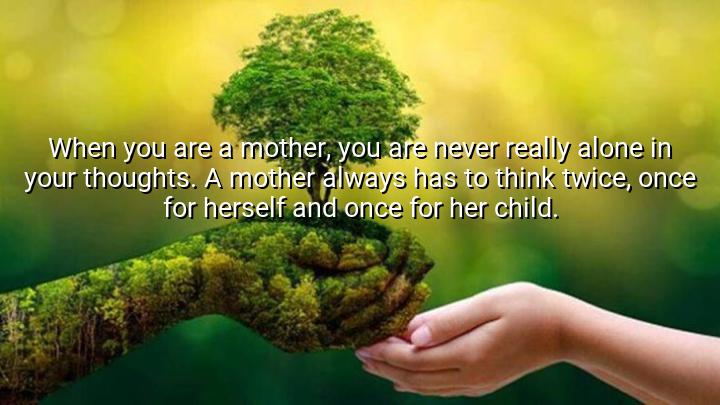




In this quote, Sophia Loren highlights the selflessness and constant responsibility that comes with being a mother. She suggests that a mother is never truly alone in her thoughts because she is always considering not only her own needs and desires but also those of her child. The idea that a mother must "think twice" reflects the dual role she plays—balancing her own well-being with the ongoing needs of her child. This constant mental shift shows how motherhood requires constant attention and sacrifice.
Loren’s words emphasize that the role of a mother involves a level of selflessness that alters the way she processes everything in life. When making decisions, mothers do not simply think of what is best for them individually but must also consider the impact on their child's life. The quote reflects the deep responsibility mothers feel, as their actions and choices are intricately tied to the well-being and future of their children.
The idea that a mother thinks “once for herself and once for her child” also underscores the concept of selflessness in motherhood. While a mother still has personal thoughts and desires, those desires are often secondary to the well-being and needs of her child. This dual focus illustrates the profound connection between mother and child, where a mother's sense of identity is often intertwined with her role as a caregiver and protector.
Ultimately, Loren’s quote captures the essence of motherhood as a state of constant awareness and compassion. It reminds us that being a mother involves not just physical care but a mental and emotional commitment that affects every decision and action. The quote reflects the complexity of motherhood and the profound bond that shapes a mother’s daily life.

TTTruong Thanh Thuy
This sentiment feels incredibly relatable, even as someone who isn’t a parent. It speaks to the quiet, constant sense of responsibility that must shape a mother’s life. But I also wonder how this affects decision-making, especially in tough situations where the mother’s and child’s needs might conflict. Does always thinking for two lead to greater empathy, or can it sometimes paralyze choices out of fear or guilt?
HAHoai Anhh
I love how this quote validates the deep emotional responsibility mothers carry. But it also makes me think—do all mothers feel this way? What about mothers who struggle to connect or feel overwhelmed? Is this kind of deep dual-awareness something that grows naturally, or is it shaped by experience, support, and confidence? I’d love to explore how universal this sentiment really is and what factors influence it.
TPTrinh Pham
This quote is tender but also a little heartbreaking. The constant mental presence of your child can feel like a blessing and a burden. Is this what we mean when we talk about 'the invisible labor of motherhood'? It’s not just what mothers do—it’s what they constantly think, plan, and feel on behalf of their kids. How can we validate and make visible this part of motherhood more clearly in policy and culture?
DDDung Doan
Reading this made me think of how emotionally layered motherhood is. You’re never truly alone—even in your quiet moments, your mind’s divided. I wonder, is this internal doubling something fathers experience too, or is it more pronounced in mothers due to cultural expectations? It would be fascinating to explore how parenting roles shape inner dialogue differently across genders and whether that’s changing with modern family dynamics.
LBLong Bajoka
Sophia Loren’s words hit me with both warmth and weight. There's beauty in always thinking for your child, but is there a danger in losing yourself in that process? Does this mental load affect a mother’s mental health or decision-making capacity? I feel like society celebrates this sacrifice without offering enough support for the psychological toll it takes. Should we be doing more to help mothers balance these dual responsibilities?