

What a child can do in cooperation today, he can do alone tomorrow.
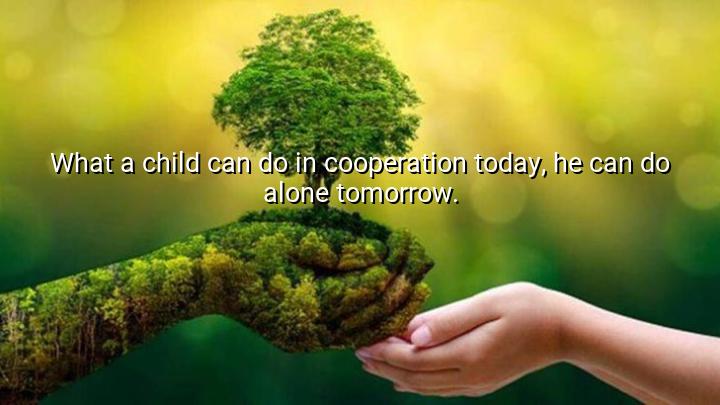




The quote "What a child can do in cooperation today, he can do alone tomorrow" by Lev Vygotsky reflects his belief in the developmental process of learning and independence. Vygotsky, a Russian psychologist, is known for his work on the social development theory, which emphasizes the role of social interaction in learning. This quote suggests that collaboration and guidance from others, especially during childhood, lay the foundation for a child's eventual ability to perform tasks independently. The idea is that through cooperation, a child can acquire the necessary skills and knowledge to eventually stand on their own and accomplish tasks without assistance.
Vygotsky’s sociocultural theory stresses the importance of social interaction in cognitive development. He believed that learning begins in a social context and that scaffolding—the process where more knowledgeable individuals support the learner—helps the child to reach higher levels of understanding and competence. The quote reflects the idea that children, with the right support, can gradually become autonomous learners as they internalize and master new skills.
The phrase "in cooperation today" highlights the role of collaborative learning, where children are guided by adults or peers, often within a zone of proximal development (ZPD)—the gap between what a child can do on their own and what they can do with guidance. Through cooperation, children are given the opportunity to practice and refine skills in a supportive environment, preparing them to act independently later.
Ultimately, Vygotsky’s quote emphasizes the developmental journey from dependence to independence. It suggests that social learning is an essential stepping stone to the eventual self-sufficiency that all individuals, especially children, will achieve as they grow. By fostering collaborative environments today, we equip children to thrive independently in the future, with the knowledge and confidence to face challenges on their own.

THBao Tran Huynh
This quote beautifully articulates a truth about human development, but I wonder—does it apply beyond childhood? Can adults also internalize new abilities through collaborative work, eventually gaining independence? It would be interesting to explore how Vygotsky’s principle plays out in the workplace, in therapy, or even in adult friendships. Maybe lifelong learning isn’t so different from early learning after all.
BP31. Bich Phuong
I find this quote both empowering and challenging. It highlights the latent potential in every child and the importance of social learning. But it raises a question for me—how can we ensure cooperation is meaningful and not just a crutch? Do all children thrive equally in cooperative environments, or do personality differences (like introversion) influence how they benefit from collaboration?
MHnguyen thi my ha
This quote strikes a deep chord with me as a mentor. It affirms the idea that our role isn’t to do things for others indefinitely but to guide them until they can do it themselves. I wonder though—how do we avoid fostering dependency in the process? There’s a fine line between helping and hindering growth. When does encouragement become interference?
TNDuong Thanh Thao Nhu
This line feels foundational to how we should approach education. It reflects the 'zone of proximal development'—the idea that children grow best when supported just beyond their current ability. But it makes me think: do adults give children enough credit for how quickly they internalize skills? And in today’s fast-paced world, are we patient enough to nurture that slow, scaffolded growth?
NANhung Alice
I love how this quote emphasizes the transformative power of collaboration. It suggests that learning isn’t just about individual effort, but about shared experiences that eventually lead to mastery. But I’m curious—how does this concept apply in classrooms with limited resources or overstretched teachers? If cooperation is key to a child’s future autonomy, then how do we ensure every child gets enough of it?