

We're all alone in this world.
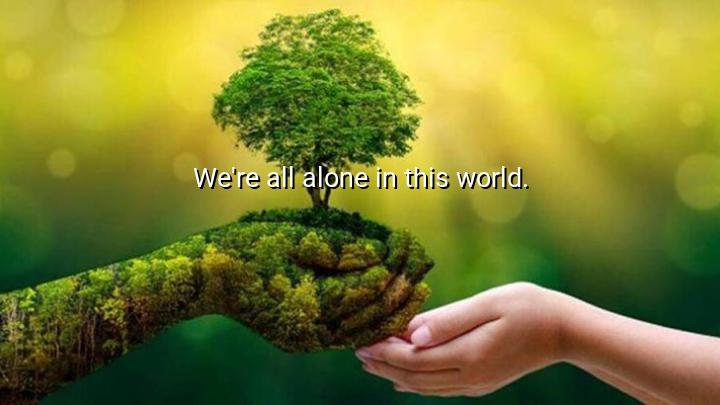




The quote "We're all alone in this world" is from Gillian Jacobs, an American actress best known for her role on the TV show Community. In this simple yet profound statement, Jacobs reflects on the inherent solitude of human existence. She suggests that, despite our connections with others, at a fundamental level, each person is alone in their experiences, thoughts, and emotions. The quote touches on the universality of human loneliness, emphasizing that this is a shared aspect of life that everyone must face.
Jacobs' words also highlight the fragility of human relationships. While we may form deep connections and rely on others for emotional support, the quote implies that no matter how close we become to someone, we are still isolated in our individuality. This can be interpreted as a commentary on how personal and internal our experiences are, even when surrounded by others.
The idea of being "alone" also speaks to the self-reliance that is required to navigate life. While relationships and social interactions are important, ultimately, we are responsible for ourselves. This realization can be both liberating and challenging, as it acknowledges the need for inner strength while also confronting the emotional difficulty of feeling isolated at times.
In essence, Jacobs' quote is a reflection on the human condition, pointing to the inescapable truth that we all experience loneliness in some form. It encourages individuals to accept this reality and find ways to cultivate resilience and self-acceptance, understanding that we are ultimately responsible for our own emotional well-being.

GDGold D.dragon
This quote really makes me want to ask—do you think this view is universally felt, or more common among certain personalities or life experiences? For example, do people who’ve dealt with abandonment or grief relate to this more than others? I feel like whether you agree with this quote depends a lot on your emotional history and worldview.
VBthinh vo ba
Is this perspective a reflection of emotional detachment, or is it a philosophical stance? It reminds me of existentialist ideas where meaning is self-made and solitude is inevitable. But if that’s true, how do we explain the comfort and sense of belonging people feel in deep relationships? Can both truths coexist—that we’re ultimately alone, yet not without meaningful bonds?
KVLe ngoc kieu vy
Reading this makes me feel a bit unsettled. If we’re all alone, what’s the point of community, friendship, or love? Are these just fleeting illusions we cling to to make existence more bearable? Or are they real even within the context of personal solitude? I’d love to hear others’ interpretations of this—does it promote self-reliance or deny human connection?
KNkim ngan
This quote sounds nihilistic at first, but it could also be interpreted as empowering. Maybe it’s a reminder that we can’t depend entirely on others for meaning or validation. I’m curious—do you think embracing aloneness can actually help us build more authentic relationships, where we connect out of desire, not need?
KPBui Khanh Phuong
I find this statement incredibly raw and honest, but it raises a big question for me—does it overlook the importance of connection and relationships? Even if we come into the world alone and leave it alone, aren’t we shaped, loved, and sometimes saved by the people around us? Is it possible that we’re not truly alone, but just deeply individual in how we experience life?