

We cannot remember too often that when we observe nature, and especially the ordering of nature, it is always ourselves alone we are observing.
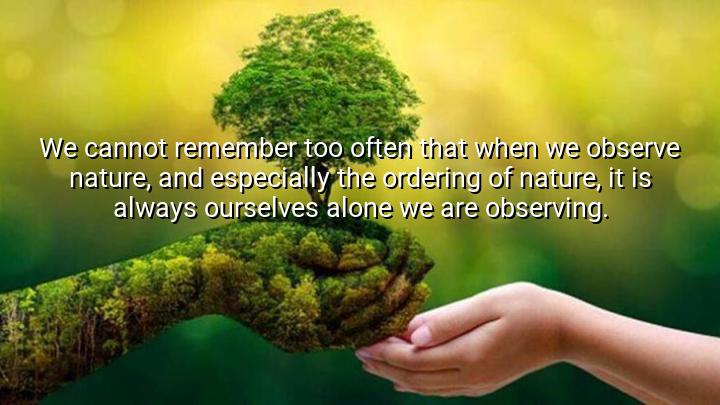




In this quote, Georg C. Lichtenberg, a German philosopher and scientist, suggests that when we observe nature, particularly its order and structure, we are ultimately reflecting on ourselves. Lichtenberg points out that human beings have a tendency to see nature not just as something separate from them, but as a mirror of their own experiences, perceptions, and thoughts. Our observations of the world around us are inevitably colored by our own subjectivity, shaping how we interpret natural phenomena.
Lichtenberg’s statement highlights the connection between human beings and nature, proposing that our understanding of the natural world is inherently tied to our own inner world. When we look at nature’s patterns, whether in the behavior of animals, the structure of ecosystems, or the laws of physics, we are also observing the ways in which we perceive, categorize, and organize our own lives. In this sense, nature is not an objective reality that exists independently of us, but is experienced and interpreted through the lens of human consciousness.
The origin of this quote lies in Lichtenberg’s broader work on human perception and science. Known for his witty and insightful aphorisms, Lichtenberg often explored the limitations and biases of human knowledge. His reflections on nature and observation suggest that much of what we "know" is influenced by our own cognitive and emotional filters, rather than an objective view of the world.
In essence, Lichtenberg’s quote calls attention to the subjective nature of human experience. It invites us to consider that when we observe nature, we are not only observing the external world but also projecting our own inner workings, beliefs, and understandings onto it. This reminder encourages us to approach our observations with awareness of how our own perceptions shape the way we see the world.

NTNam Trung
This quote makes me wonder about the creative and interpretive aspects of how humans engage with nature. Is the ‘ordering’ of nature a discovery or a construction? How might this view encourage humility in our claims about understanding the natural world? It’s a reminder that our knowledge is deeply intertwined with who we are.
VHvu hoang
Lichtenberg’s words prompt me to think about the role of subjectivity in all observation. How do our cultural, emotional, and cognitive filters influence what we see in nature? Can we ever step outside ourselves to experience pure, unmediated observation? This challenges the idea of detached, neutral observation in both science and art.
NUnii uyen
I’m intrigued by the philosophical implications of this quote. If nature’s ordering is a mirror of ourselves, what does that say about our place in the universe? Does it suggest a unity between observer and observed, or a limitation in our ability to grasp external reality? It invites reflection on the nature of perception and knowledge.
TTNguyen Huynh Thanh Truc
This idea that observing nature is essentially observing ourselves is fascinating. Could it imply that the patterns and order we perceive in nature are projections of our mental frameworks? How does this affect our understanding of objectivity in science? It raises questions about the interplay between human consciousness and the natural world.
VANguyen Van A
Lichtenberg’s quote suggests a deeply subjective relationship between humans and nature. Does this mean our observations are always filtered through our own perspectives and biases? How might this shape scientific inquiry and philosophical reflection? It makes me question whether we ever truly see nature as it is, or only as a reflection of ourselves.