

We believe that the farm should be building 'forgiveness' into the ecosystem. What does that mean? That a more forgiving ecosystem is one that can better handle drought, flood, disease, pestilence.
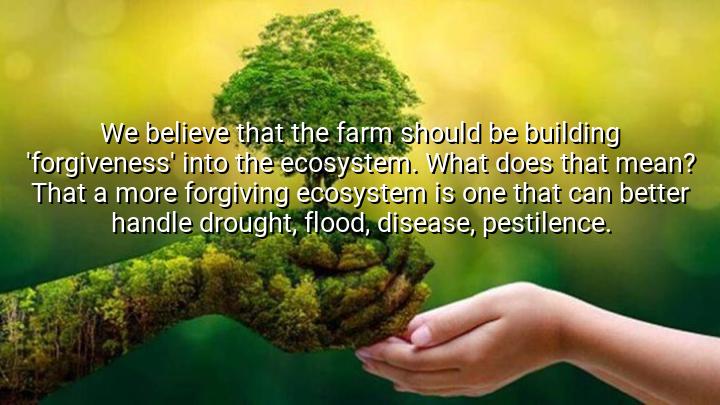




Joel Salatin’s quote reflects his belief in creating a forgiving ecosystem in agricultural practices. By saying the farm should be building 'forgiveness' into the ecosystem, Salatin is advocating for a system where the environment is resilient and adaptable, able to recover from stressors like drought, flood, disease, and pestilence. In his view, a forgiving ecosystem doesn’t just endure these challenges but recovers and flourishes in the face of them, much like how forgiveness in human relationships allows for growth and healing after conflict or hardship.
The origin of this quote comes from Salatin’s work as a farmer and advocate for sustainable agriculture. Known for his innovative farming methods at Polyface Farm, Salatin focuses on creating systems that work in harmony with nature rather than against it. His use of the term forgiveness to describe the ecosystem is a metaphor for resilience—the idea that nature can be designed in a way that it can bounce back from adversities, just as forgiveness allows individuals or communities to recover from harm and move forward.
Salatin’s concept of a forgiving ecosystem aligns with his broader philosophy of regenerative agriculture, which aims to improve soil health, increase biodiversity, and reduce the environmental impact of farming. By building forgiveness into farming systems, Salatin believes that farmers can create more sustainable and self-sufficient environments that don’t rely heavily on synthetic chemicals or industrial practices. In this way, the farm becomes not just a place of production but a living system that reflects the balance and interconnectedness of natural cycles.
Ultimately, Salatin’s quote underscores the importance of creating agricultural systems that can withstand and recover from external pressures, reflecting the concept of forgiveness as a tool for long-term sustainability. It challenges conventional agricultural practices that prioritize efficiency over resilience, urging farmers and environmentalists to focus on building systems that are adaptable, healthy, and capable of maintaining equilibrium despite the challenges that inevitably arise.

AAdministratorAdministrator
Welcome, honored guests. Please leave a comment, we will respond soon