

Our land-healing ministry really is about cultivating relationships: between the people, the loving stewards, and the ecology of a place, what I call the environmental umbilical that we're nurturing here.
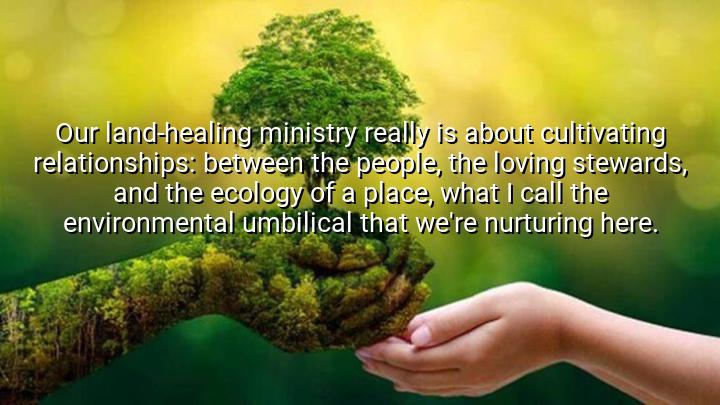




Joel Salatin's quote highlights the idea that land-healing is not just about physical restoration, but also about fostering relationships—specifically between people, the ecology of a place, and the concept of stewardship. He argues that true environmental healing happens when people become responsible, loving stewards of the land, working in harmony with nature rather than exploiting it. This relationship forms the foundation of his ministry, which emphasizes sustainable, regenerative farming practices.
The phrase “environmental umbilical” is a metaphor Salatin uses to describe the deep, nurturing connection between humans and the environment. Just as the umbilical cord connects a mother and her child, this "umbilical" represents the essential, symbiotic relationship between people and the land. Salatin believes that by cultivating such connections, humans can restore the land in a way that is both sustainable and respectful, ensuring that future generations can continue to benefit from its resources.
Joel Salatin, a well-known farmer and advocate for sustainable agriculture, operates his farm on the principles of holistic land management. His approach is grounded in the belief that healthy land, healthy food, and healthy communities are interconnected. By calling his work a ministry, Salatin emphasizes the spiritual and ethical dimensions of farming, positioning it as a calling that involves care, responsibility, and connection with the earth.
Salatin's quote also touches on the broader theme of ecological stewardship, a principle that calls for taking responsibility for the environmental well-being of the land we inhabit. His vision of land-healing reflects a growing movement in agriculture that seeks to restore ecosystems through thoughtful, regenerative practices. The concept of nurturing a relationship with the land rather than simply extracting from it is central to the sustainability of our natural resources.

AAdministratorAdministrator
Welcome, honored guests. Please leave a comment, we will respond soon