

We are nothing if we walk alone; we are everything when we walk together in step with other dignified feet.
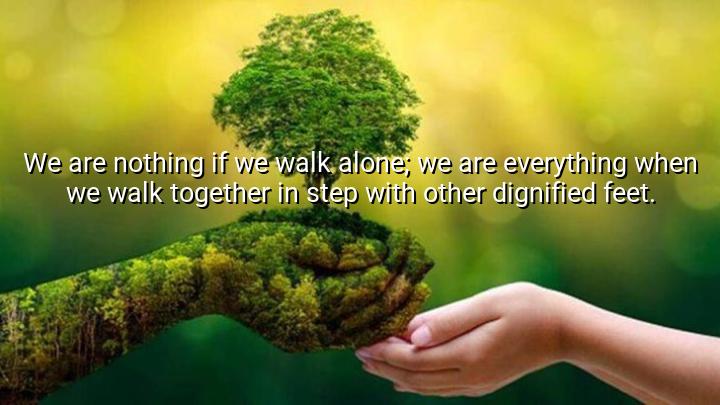




In this quote, Subcomandante Marcos, a leader of the Zapatista movement in Mexico, emphasizes the importance of unity and solidarity. He suggests that as individuals, we are insignificant or "nothing" when we act alone, but when we come together and walk together in harmony with others, we become powerful. The phrase "in step with other dignified feet" underscores the idea that true strength arises from collective action and the shared dignity of those involved in a common struggle or cause.
The quote highlights the idea that individualism alone is not sufficient for achieving meaningful change or progress. Instead, it is the collective efforts of people walking together, with shared purpose and mutual respect, that leads to true power. The dignity mentioned here suggests that the individuals coming together are not only united in action but are also motivated by a sense of honor and respect, reinforcing the idea of solidarity as a means of achieving both justice and freedom.
Marcos’ words also reflect the broader philosophy of the Zapatista movement, which advocates for the rights of indigenous people, social equality, and resistance against oppression. By invoking the image of walking together with dignity, he speaks to the strength that comes from collective action, where each individual is valued and respected within the larger community effort. This notion of shared dignity is integral to the movement's call for empowerment and solidarity among marginalized groups.
Ultimately, this quote serves as a reminder that community and cooperation are essential for meaningful progress. By walking together, with a sense of dignity and purpose, individuals can amplify their impact, demonstrating the power of unity in confronting challenges and achieving collective goals.

MTPhung Ha Minh Trang
This quote feels like a call to humility. It suggests that no matter how capable or accomplished we are, our worth is amplified through collective purpose. That challenges a lot of Western notions of self-made success. But I do wonder—how do we teach this value of interdependence without making people feel diminished individually? Can community empowerment and personal ambition coexist without tension?
NVnguyen vy
I love how poetic and revolutionary this quote feels—it reminds me of protest marches and grassroots movements. It evokes a sense of rhythm and purpose. But I wonder, in today’s fractured political climate, can we still find that 'in-step' unity across differences? Or has polarization made this kind of dignified togetherness harder to achieve? I want to believe it’s still possible, but I’m not so sure anymore.
AAAy ay ay
This resonates deeply with me as someone who’s always valued independence, sometimes to a fault. It challenges the idea that strength lies in going it alone. Could it be that real power comes not from personal grit, but from aligning with others? And yet, in a world that glorifies individual achievement, how do we shift toward this more communal perspective without losing our sense of self?
BNDo Binh Nhi
I’m struck by how this line elevates dignity as essential to togetherness. It’s not just about walking with others—it’s about walking with those who carry themselves with integrity. Does that mean solidarity only works when everyone shares a moral compass? What happens when you're aligned in cause but differ in methods or ethics? This quote raises deeper questions about the character of the company we keep.
BCPhan Bao Chau
This quote feels like a powerful anthem for collective action and solidarity. But it makes me wonder—what does it truly mean to 'walk in step' with others? Does it require full agreement, or is it enough to share mutual respect and a common goal? In movements where diverse voices come together, how do we balance unity with individuality? It's beautiful in sentiment, but real-world unity often seems more complicated.