

We are not weak if we make a proper use of those means which the God of Nature has placed in our power... the battle, sir, is not to the strong alone it is to the vigilant, the active, the brave.
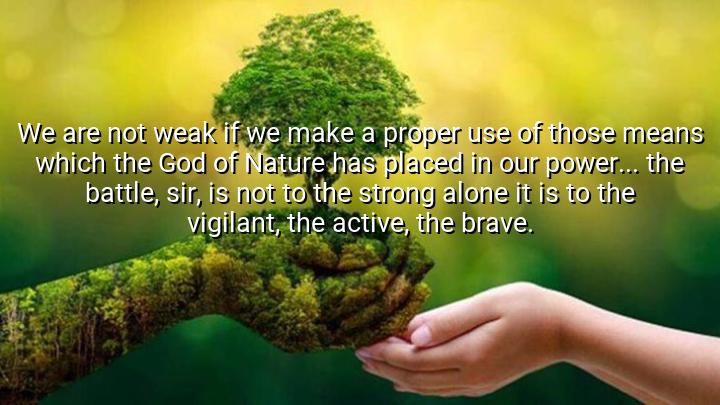




In this quote, Patrick Henry encourages the use of available resources and emphasizes that strength alone is not the key to success. He asserts that weakness is not inherent in people who make effective use of the means at their disposal, which the God of Nature has provided. Henry is suggesting that individuals have the power to succeed through vigilance, action, and bravery, even if they do not possess physical strength. This reflects his belief that inner qualities, like perseverance and courage, are often more important than mere strength.
Henry’s message is a call to action, urging people to be active and to approach challenges with a combination of awareness and determination. He stresses that success in battle—whether literal or metaphorical—does not solely belong to the physically strong, but to those who remain alert, prepared, and willing to take action. This suggests that tactical awareness and the ability to adapt are just as crucial as physical power in overcoming obstacles.
The quote also underscores the importance of courage and resolve. Henry distinguishes between physical might and moral or intellectual strength, stating that a person who is brave and proactive will have an advantage, regardless of their strength. The real battle is won by those who possess courage to face challenges head-on and take the necessary steps to overcome them.
Ultimately, Henry’s quote serves as a reminder that victory is not always determined by brute strength but by the qualities of vigilance, activity, and bravery. It encourages individuals to tap into the full range of their abilities, including mental strength and resilience, to achieve success and face adversity.

HLDau Ha Linh
I’m struck by how spiritual this quote feels, invoking the 'God of Nature' and framing our tools as divinely provided. Do you think this belief in a higher natural order adds moral weight to the argument? I wonder how someone who doesn’t share that worldview would interpret it—does the message lose power, or can it stand on its own as a secular call to personal agency and courage?
QG08.8.7 Nguyen Thi Quynh Giao
There’s something timeless about this quote—it feels like it could motivate anyone facing a difficult choice. But it also makes me wonder: are people who are less brave or less outwardly active automatically seen as weak? That feels unfair. What about those who work quietly behind the scenes or practice patience instead of confrontation? Is there room in this framework for different kinds of strength beyond the heroic ideal?
MCNg Ngoc Minh Chau
Patrick Henry’s words sound like a call to arms, and I can see how powerful they’d be in a revolutionary context. But I’m curious—how would this quote be received in a time of peace? Can the same principles apply to internal battles, like overcoming fear or injustice, without resorting to actual conflict? I think the idea of using our natural gifts wisely still applies, but in more nuanced ways.
HNhop ngongo
I find this statement incredibly motivational. It reminds me that strength isn’t always about size or force—it’s about attitude and readiness. But I also wonder, is this message sometimes misused to glorify conflict or push people into unnecessary battles? Where’s the line between being brave and being reckless? I’d love to hear how others interpret the balance between courage and caution in difficult circumstances.
VQNguyen Viet Quang
This quote inspires a sense of empowerment, but it also raises a question for me—how do we know if we’re properly using the resources or talents available to us? It’s easy to feel weak or overwhelmed even when we have potential. I wonder if Patrick Henry is suggesting that strength is more about awareness and courage than physical might. But in today’s complex world, is vigilance and bravery still enough to overcome adversity?