

We are for the most part more lonely when we go abroad among men than when we stay in our chambers. A man thinking or working is always alone, let him be where he will.
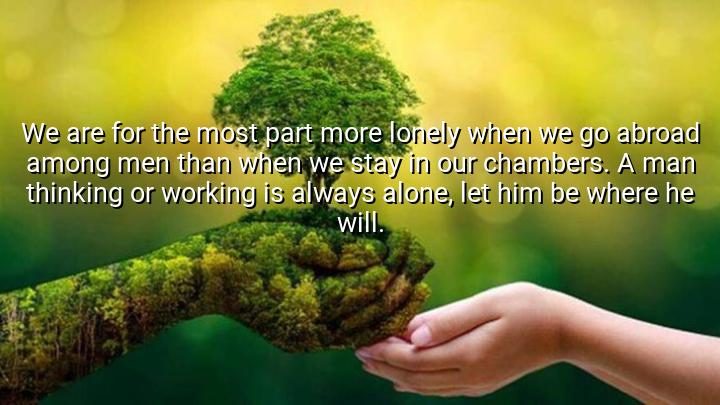




The quote "We are for the most part more lonely when we go abroad among men than when we stay in our chambers. A man thinking or working is always alone, let him be where he will" by Henry David Thoreau reflects on the concept of loneliness and solitude in the context of society and personal thought. Thoreau suggests that despite being surrounded by people, one can feel more isolated in society than when alone in their own private space. This underscores the idea that true loneliness is not necessarily the physical absence of others, but the lack of meaningful connection and introspection.
Henry David Thoreau, an American essayist, poet, and philosopher, is most famous for his work Walden, in which he advocates for a life of simplicity, self-sufficiency, and reflection. Thoreau believed in the importance of solitude for personal growth and clarity. This quote aligns with his larger philosophy, which suggests that spending time alone in thought or work can lead to a deeper sense of connection with oneself, while social interactions, especially those that lack substance, can contribute to a feeling of disconnection.
Thoreau’s statement about being "always alone" when thinking or working highlights the fact that when one is deeply engaged in contemplation or creation, the mind is focused inward, regardless of the external environment. This suggests that, even in a crowd, a person can be emotionally or intellectually isolated. For Thoreau, the act of thinking or working is a deeply personal experience that often requires solitude to fully engage in.
Ultimately, Thoreau’s quote encourages us to reconsider the nature of loneliness and community. It challenges the idea that company automatically alleviates loneliness, proposing instead that meaningful reflection and personal engagement with our work can provide a deeper sense of fulfillment than the shallow interactions we may encounter in society. The quote highlights the value of spending time in solitude to reconnect with one's inner self, rather than relying on external companionship to feel whole.

TTHuynh Thanh Thao
Thoreau’s perspective is powerful, and it aligns with the idea that solitude is often chosen, while loneliness in public feels imposed. But I wonder — in today’s world of hyper-connectivity, does this hold up? Can someone still feel 'alone' while interacting online, or has the nature of solitude evolved? This quote makes me reflect on how thinking deeply is often less about isolation and more about interior richness.
BNBich Ngoc
This quote captures something I’ve always struggled to explain — that feeling of being more alone in a crowd than when you’re physically by yourself. It makes me think: are we lonelier when we’re surrounded by people who don’t truly understand us? Maybe that’s why intellectual or creative work feels inherently solitary — because it’s such a personal process, one few can fully witness or share.
UNUoc Nguyen
There’s a kind of quiet resignation in this quote that I find both wise and sad. It suggests that being among others doesn’t guarantee connection, and maybe even amplifies our internal isolation. But should we accept that as a universal truth? Can’t we learn to be present with others in ways that feel meaningful? Or are moments of deep thinking always destined to be solitary acts?
PDPhung Dung
I find this quote beautifully introspective, but also a bit isolating. Is it really true that thinking or working makes us fundamentally alone? Or is that just a perception we’ve accepted? What about collaborative creativity or intellectual connection — can’t those moments offer both productivity and togetherness? I respect Thoreau’s philosophy, but I also wonder if it’s too rooted in individualism to reflect every kind of experience.
TBTUYEN BICH
This quote really made me pause. It’s fascinating how Thoreau suggests that loneliness is more acute in crowds than in solitude. I’ve definitely felt lonelier in a room full of people than by myself. Is it because when you're alone by choice, you're connected with your own thoughts — but in company, disconnection can feel sharper? It makes me wonder whether true loneliness is about emotional presence, not physical proximity.