

We allow our ignorance to prevail upon us and make us think we can survive alone, alone in patches, alone in groups, alone in races, even alone in genders.
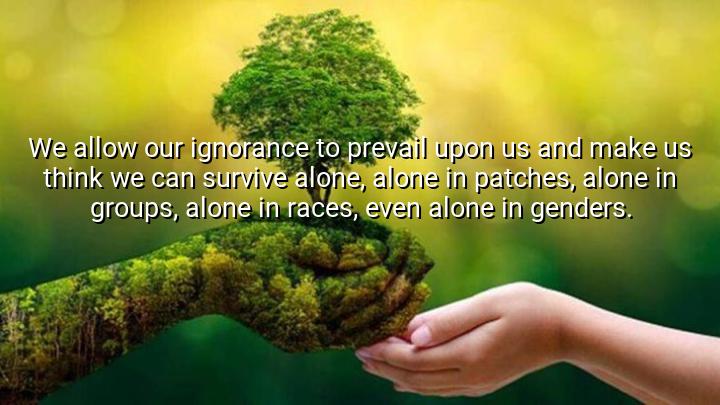




The quote "We allow our ignorance to prevail upon us and make us think we can survive alone, alone in patches, alone in groups, alone in races, even alone in genders" by Maya Angelou is a powerful statement on the illusion of separation and the danger of isolation—both individual and collective. Angelou emphasizes that our belief in self-sufficiency, whether as individuals or communities, is often rooted in ignorance, not strength. She warns that no person, group, race, or gender can truly thrive in isolation.
Maya Angelou, a celebrated poet, memoirist, and civil rights activist, was known for her eloquent reflections on identity, unity, and the shared human experience. This quote reflects her belief in the interconnectedness of all people. She challenges us to move beyond the false sense of independence that divides us, and to recognize that our survival—both emotional and societal—depends on mutual understanding and collaboration.
The repetition of the word "alone" in different contexts—patches, groups, races, genders—highlights the many ways we try to separate ourselves from others. Angelou suggests that these divisions are artificial and self-defeating, because they prevent us from seeing our shared humanity. When we believe we can exist entirely apart from others, we lose the opportunity to learn, grow, and support one another.
Ultimately, Angelou’s quote is a call to reject division and embrace solidarity. She reminds us that ignorance fosters isolation, but awareness and connection bring strength. Only by recognizing that we are in this together—across all boundaries—can we hope to create a more compassionate, inclusive, and resilient world.

VTHuynh Van Thien
The quote makes me reflect on the way we organize society — from policies to personal relationships. If isolation is a form of ignorance, how do we unlearn it? Can education systems do more to foster interconnected thinking, or is this a moral transformation that has to come from within individuals? I’d love to hear perspectives on where responsibility lies: institutions, individuals, or both?
THHuynh Thanh Huy
Do you think the myth of rugged individualism has caused more harm than good? This quote makes me reconsider the narratives we've been fed about 'making it on your own.' Why is collective survival still treated as a radical idea? It almost feels like we’re being taught to ignore our human instincts for connection and cooperation. That’s both fascinating and kind of frightening.
LLLam lan
This quote hits hard when you reflect on current societal divisions — race, gender, identity, politics. It raises a tough question: can true progress ever happen if we continue to isolate within our 'patches'? I’m wondering, what does it really mean to work toward unity without erasing difference? Can solidarity exist without sameness, and if so, how do we practice that?
LHHoang Lan Huong
I find this quote powerful and unsettling. It makes me think about how we often build walls between ourselves and others under the guise of self-sufficiency. Why do we see needing others as weakness instead of wisdom? I wonder, how different would our communities look if we fully embraced our need for collective survival, not just emotionally but structurally, politically, and economically?
NLHan Ngoc Linh
Is it possible that in today’s hyper-connected world, we still haven’t fully accepted how deeply interdependent we are? Reading this quote makes me wonder how much of our social and political dysfunction stems from an illusion of independence. I’m curious — do you think this denial of interdependence is something we’re taught culturally, or is it more of a psychological defense mechanism rooted in fear or pride?