

Virtue is not left to stand alone. He who practices it will have neighbors.
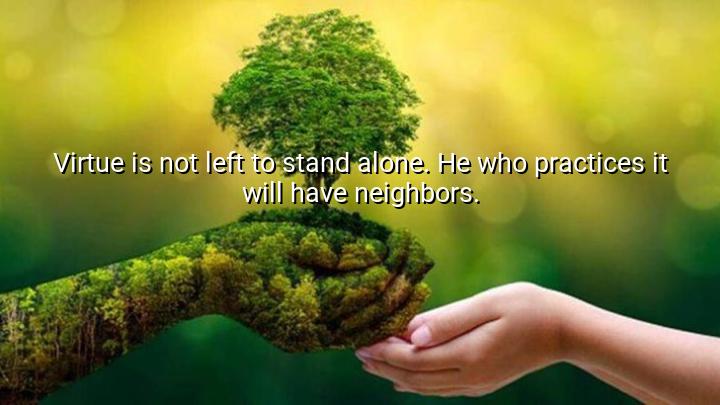




The quote "Virtue is not left to stand alone. He who practices it will have neighbors" by Confucius highlights the social nature of virtue and the impact it has on relationships within a community. Confucius suggests that practicing virtue—such as honesty, kindness, integrity, and respect—not only benefits the individual but also attracts others who are drawn to these qualities. Virtue, in this sense, cannot exist in isolation, as it creates bonds and fosters connections with others who share or admire these values.
Confucius, a Chinese philosopher and the founder of Confucianism, emphasized the importance of moral character, social harmony, and proper conduct in life. This quote reflects his belief that moral actions and virtuous behavior are inherently social, and that living virtuously fosters healthy, meaningful relationships within society. He believed that a person’s virtue could influence others to live in harmony, thus contributing to the overall well-being of the community.
The phrase "He who practices it will have neighbors" implies that a person who lives with virtue naturally attracts others into their life—people who seek similar values or are inspired by the person's ethical behavior. This reinforces the idea that virtue is not just about personal moral development, but about creating a positive influence in the world and fostering a sense of community.
Ultimately, Confucius’s quote teaches that virtue is a relational quality that thrives within social interactions. It encourages individuals to practice virtue not for personal gain alone but to build connections and create a harmonious society. Through virtuous living, one does not remain isolated but becomes a catalyst for fostering positive relationships and contributing to the collective good.

TT12a1_24_ Tan Tai
I’m intrigued by the relational aspect of virtue in this quote. It’s not portrayed as something solitary or abstract, but something inherently social. Could it be that practicing virtue isn’t just about personal morality but about cultivating a shared ethical space? If so, are we responsible not only for being good but for building community through goodness? That feels like both a privilege and a heavy responsibility.
TLThanh Le
Reading this made me wonder—does this quote also serve as advice to those feeling disheartened in their moral efforts? Like, maybe it’s a reminder not to give up, because living rightly will eventually bring support and connection. I think it’s encouraging, especially for people who feel like they’re doing the right thing in silence. But what about those who never seem to find that community? Are they still virtuous?
FG006 FF Gaming
Is the underlying message here that goodness is magnetic? That’s a beautiful notion, but it raises questions: is it the virtue itself that attracts people, or is it the consistency and trust it builds over time? Do people gather around virtue because of admiration, shared values, or perhaps even a desire for guidance? I’m curious what kinds of ‘neighbors’ Confucius had in mind—literal companions or fellow moral travelers?
TDNguyen Thi Duyen
I find this Confucian thought really comforting, but is it culturally dependent? In collectivist societies, virtuous acts may be more visibly supported. But in more individualistic settings, can acting with integrity sometimes feel lonely? I wonder how this principle plays out differently depending on social norms or values. Does virtue really always attract company, or does it sometimes demand solitude before it earns respect?
QQuyen
This quote made me think about how our actions ripple outward. Could it be that living virtuously not only draws others in, but also inspires them to elevate their own behavior? I’d love to believe in that kind of moral domino effect. But what happens when you try to act with integrity in an environment where selfishness or corruption are the norm? Does virtue still have power there?