

This, then, is the test we must set for ourselves; not to march alone but to march in such a way that others will wish to join us.
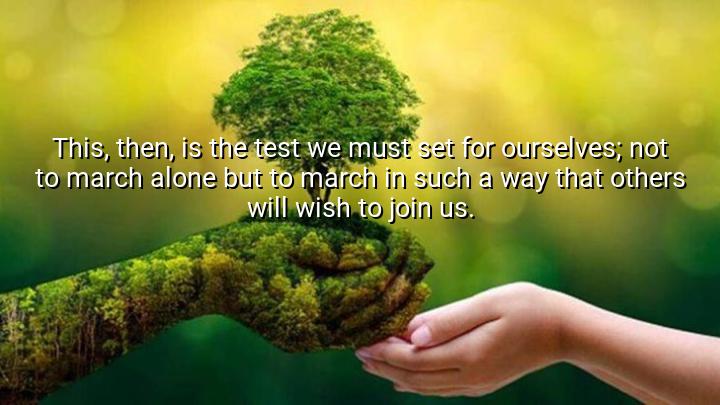




The quote "This, then, is the test we must set for ourselves; not to march alone but to march in such a way that others will wish to join us" is from Hubert H. Humphrey, a former Vice President of the United States and a prominent figure in American politics. In this statement, Humphrey reflects on the idea of leadership and influence. He suggests that true leadership is not about standing alone or striving for personal success, but about inspiring others through action and example, so that they are motivated to join and support the cause.
Humphrey's words emphasize the importance of collective effort and the role of a leader in uniting people toward a common goal. Rather than focusing on personal achievement, he suggests that one should lead in a way that others are naturally drawn to follow. The phrase "march in such a way that others will wish to join us" highlights the concept of inspiration, where leadership is shown through action, values, and the ability to bring people together, rather than by commanding or demanding allegiance.
The quote also speaks to the idea that leadership is not imposed but is a result of how one conducts themselves and influences others. Leaders who embody qualities like integrity, vision, and purpose naturally attract others who share the same values, creating a movement or cause that people want to be a part of. It’s a call for leaders to not just focus on their own path, but to make the journey so compelling that others are inspired to join.
In essence, Humphrey’s quote encourages a leadership style that is inclusive and inspiring, one that seeks to build a community of followers based on shared goals and values. It emphasizes the idea that leadership is not about isolation, but about leading in such a way that others feel compelled to be a part of something greater than themselves. The test for leadership, according to Humphrey, is whether you can inspire others to walk alongside you.

QHNguyen Vu Quang Huy
There’s something incredibly noble about the idea of marching with integrity and inclusion. But it also sounds idealistic. Do you think it’s possible to lead like this in politics or business today, where power often comes from control or dominance rather than inspiration? Maybe the real test is whether we can lead with both strength and grace.
AMAnh Mai
Reading this made me reflect on activism and social change. True impact isn’t just about being loud or bold—it’s about being compelling enough that others feel drawn to your cause. But is that harder today, in such a polarized world? Can we still lead in a way that unites rather than divides?
NTTruong Nhat Tam
This quote challenges the lone hero myth and replaces it with a model of leadership based on invitation and shared purpose. But that raises a tough question—what if your values clash with what the majority want? Should you change your pace to match the crowd, or keep marching in the hope that the right people eventually fall in step?
LAlan anh
There’s such humility in this idea. Instead of assuming we’re right and charging ahead, it asks us to lead with empathy and vision that resonates with others. But I wonder—what happens when no one wants to join you? Does that mean you’re failing, or just ahead of your time? How do you stay motivated when your march feels lonely?
CECha eunwoo
This quote really makes me think about leadership and influence. It’s not enough to have strong convictions—you also have to express them in a way that inspires and invites others. But how do we balance staying true to our principles while also being approachable? Can trying too hard to be inclusive water down the very cause we’re trying to champion?