

There is no end of craving. Hence contentment alone is the best way to happiness. Therefore, acquire contentment.
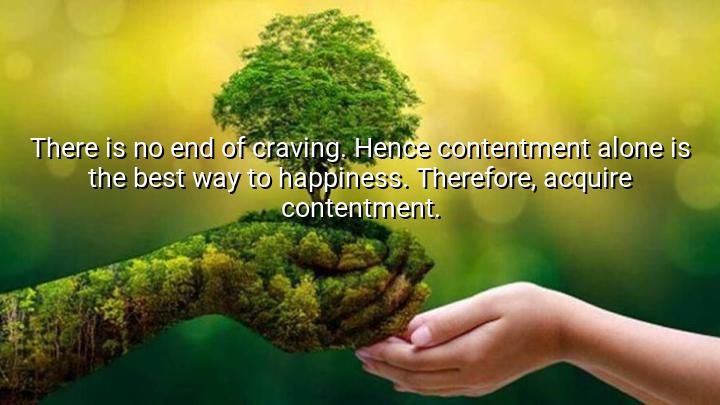




In this quote, Swami Sivananda addresses the human tendency toward constant craving and the pursuit of more, which often leads to dissatisfaction. He states, "There is no end of craving," highlighting the idea that the desire for material possessions, achievements, or experiences can never be fully satisfied. This cycle of craving and seeking more is endless, and it often leaves individuals feeling unfulfilled, no matter how much they acquire.
Sivananda then suggests that contentment is the key to true happiness. Instead of chasing after fleeting desires, he advocates for cultivating a sense of inner peace and satisfaction with what one has. Contentment is described as the best way to achieve lasting happiness, as it is rooted in acceptance and gratitude for the present moment, rather than in the constant pursuit of external rewards. By embracing contentment, a person can experience a deeper sense of fulfillment that transcends material cravings.
The message of the quote aligns with the teachings of many spiritual traditions, where inner peace and contentment are seen as essential for mental and emotional well-being. Acquiring contentment, as Sivananda advises, involves letting go of the endless chase for more and instead focusing on finding joy and peace within oneself. This approach leads to a more stable and enduring form of happiness that is not dependent on external circumstances.
Ultimately, Sivananda’s quote serves as a reminder to focus on cultivating contentment rather than falling into the trap of constant craving. True happiness, according to him, is not found in accumulating more but in learning to appreciate and accept what is already present in one's life.

NBThy Ngo Bao
This idea makes me reflect on the paradox of craving: it promises happiness but usually leads to dissatisfaction. I agree with the quote, but I wonder—why are we so resistant to contentment? Is it fear of missing out, or are we addicted to the excitement of striving? I’d love to hear perspectives on how spiritual traditions across cultures teach contentment as a path, not a passive state.
OAOrr Alain
Swami Sivananda’s teaching feels like a call to internal revolution. But how do we reconcile contentment with a world that also needs activism and change? If someone is deeply content, do they still feel compelled to fight injustice or push for social progress? Or does true contentment include compassion and a desire to help others find peace too? I’m wrestling with how contentment fits into responsibility.
LNnguyen linh nhi
This quote makes me think about how much of our suffering comes not from what we lack, but from what we expect. If craving is endless, then maybe peace really does begin with saying 'enough.' But isn’t it hard to know when enough is enough? Especially when social media, advertising, and even peers constantly raise the bar? Is contentment a personal declaration of independence from that noise?
Nngan
I find this quote comforting, yet it also raises a tough question: how do you acquire contentment if your circumstances are really difficult? Is it something you learn through discipline, or is it more of a spiritual realization that grows over time? I struggle to imagine feeling content when basic needs aren’t met. Does contentment require detachment from desire, or a shift in how we define happiness?
MTMai Thuong
Sivananda’s wisdom feels timeless, but I wonder—is contentment the same as complacency? If we train ourselves to be content, do we risk losing our drive or ambition? Or is there a difference between peaceful acceptance and stagnation? I’m curious how this principle applies to personal growth. Can we be fully content and still pursue change or improvement without falling into the trap of constant craving?