

There is a destiny which makes us brothers; none goes his way alone. All that we send into the lives of others comes back into our own.
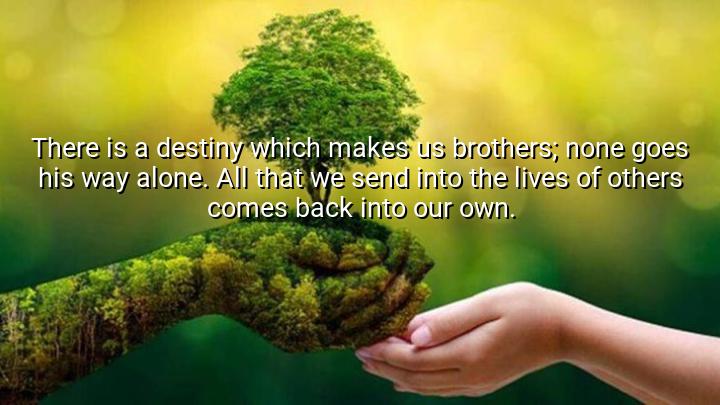




The quote "There is a destiny which makes us brothers; none goes his way alone. All that we send into the lives of others comes back into our own" by Edwin Markham reflects the idea of interconnectedness and the reciprocal nature of human relationships. Markham suggests that there is a greater destiny or force that binds us together, making us not only individuals but also part of a larger human family. Our actions and choices impact others, and, in turn, the energy and goodness we share with the world ultimately returns to us, creating a cycle of mutual support and responsibility.
Edwin Markham, an American poet and social reformer, was known for his works that focused on themes of justice, equality, and human dignity. His poetry often emphasized the importance of compassion and solidarity. This quote is an example of his belief in the collective nature of humanity, where each person’s journey is connected to others, and the actions we take ripple outward, affecting the lives of those around us.
The phrase "none goes his way alone" highlights the essential truth that no matter how independent we may feel, our lives are deeply influenced by others. Whether through our relationships, shared experiences, or the impact we have on others, we are never truly isolated in our actions. Markham underscores the importance of community and the understanding that individual success or fulfillment often depends on the connections we build and the support we receive from others.
Ultimately, Markham’s quote encourages a sense of responsibility and compassion toward others, reminding us that every kindness, act of generosity, or support we offer will return to us in some form. It is a call to live with awareness of how our actions affect the greater human family, fostering a sense of unity and shared purpose. By contributing positively to others' lives, we not only help them but also enrich our own.

HHuy
This quote feels timeless, like a moral compass wrapped in verse. But I’m curious—how do we balance this idea of shared destiny with the need for personal boundaries? If everything we send into others’ lives returns to us, where does accountability end and self-preservation begin? I love the sentiment, but I also want to explore how it fits in complex relationships, especially where giving isn’t always mutual.
TVnguyen thnah van
I love the rhythm and message of this quote—it feels like something that belongs on a classroom wall or a peace summit. But it also raises a deeper question for me: is this belief in shared destiny something we feel naturally, or something we need to be taught? Do we grow up understanding our connection to others, or is it something we only grasp through hardship and reflection?
TTTran Tuan Thanh
This quote reminds me of the ripple effect—how even small acts of kindness or cruelty can echo in ways we might never see. It makes me reflect: are we ever truly separate from others, or is our sense of individualism just an illusion? Maybe Markham is suggesting that even our private actions are social ones, because we’re always part of a larger, interconnected fabric.
ASThao a sau
What strikes me is the idea that no one goes their way alone. It sounds beautiful, but I wonder—does it acknowledge the reality of people who feel completely isolated or abandoned? Does destiny still bind those who’ve been left behind or mistreated by others? I think the sentiment is noble, but I’d love to explore how this quote holds up for those living on the margins.
HLhanh luu
I find this quote really powerful, almost like a poetic version of karma or moral reciprocity. It makes me think—do we fully understand the impact of our actions on others? And if everything we give returns in some form, how do we make sure we’re sending out empathy, not indifference? I love the idealism here, but it also feels like a call to be more mindful every day.