

Then stirs the feeling infinite, so felt In solitude, where we are least alone.
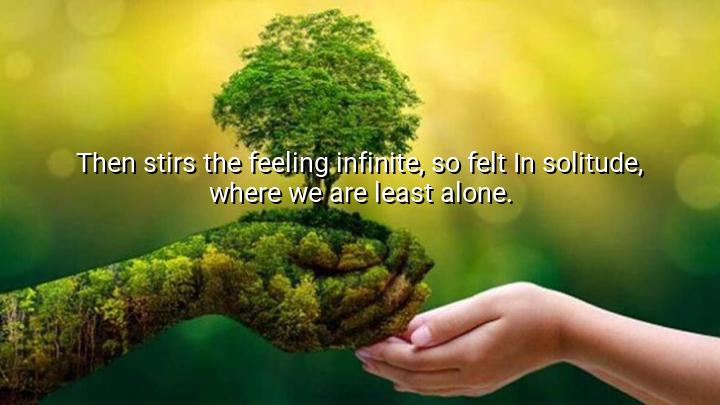




The quote "Then stirs the feeling infinite, so felt In solitude, where we are least alone" by Lord Byron expresses the profound sense of connection, awe, and spiritual awareness that can arise in moments of solitude. Rather than being empty or isolating, being alone—especially in nature or quiet reflection—can awaken a feeling of being part of something greater, something infinite. Byron suggests that in these moments, we paradoxically feel most connected to the universe, to truth, or to the depths of our own soul.
This line comes from Byron’s poem “Childe Harold’s Pilgrimage,” a semi-autobiographical work that explores themes of wanderlust, melancholy, and the search for meaning. As one of the leading figures of the Romantic movement, Lord Byron often emphasized the emotional power of nature, the beauty of solitude, and the importance of individual experience. In this context, solitude is not a withdrawal but a gateway to transcendence and inner clarity.
The phrase “feeling infinite” captures the Romantic ideal of encountering the sublime—a state where one feels overwhelmed not by fear or loneliness, but by the vastness and beauty of existence. In such moments, the boundaries between the self and the world seem to dissolve. Byron's insight is that this powerful sensation is most often felt when we are alone, undistracted by society and attuned to our inner world.
Ultimately, this quote invites us to reframe solitude not as emptiness but as a space where we can feel deeply alive, connected, and whole. Lord Byron celebrates solitude as a moment of spiritual fullness, where we discover that we are never truly alone when we are in harmony with the infinite.

MTnguyen mai thuy
This quote raises a big question for me—what does it mean to be alone, really? Byron seems to suggest that solitude is where we’re most in touch with truth, emotion, maybe even the divine. But in an age where silence is rare and constant interaction is the norm, have we lost the ability to feel that ‘infinite’ presence he’s describing?
TLAnh Thu Truong Le
Byron’s words make solitude sound almost sacred. But is this experience of being 'least alone' in solitude something only some people feel? Maybe introverts or artists? Or is it a universal potential we’ve forgotten how to access? I think it’s fascinating how solitude, often feared or avoided, can instead be a portal to the most intimate kind of connection.
TT14 Vo Ngoc Thanh Truc
There’s such a profound stillness in this line. I think it speaks to the way solitude opens us up to feelings we can’t access when surrounded by noise, people, or obligation. What is that 'infinite' Byron talks about? Is it the soul? The universe? The collective unconscious? Whatever it is, it’s something I think we all quietly long for, even if we don’t always know how to find it.
GDGold D.dragon
This quote is so moving. It makes me think of those rare moments when you’re alone in nature or in stillness and suddenly feel part of something vast and eternal. I wonder if that’s what Byron meant—the paradox that solitude strips away distractions and brings us closer to everything. Can we cultivate that feeling more intentionally in modern life, or is it too full of noise?
BHNguyen Ngoc Bao Han
I love how this quote flips the whole narrative on solitude. Usually we associate solitude with being cut off, but Byron suggests it’s actually where we feel the most connected. That makes me wonder—connected to what? Ourselves, nature, a higher consciousness? I think there’s something poetic in the idea that only in silence can we hear the deeper truths of existence.