

The starting point of discovering who you are, your gifts, your talents, your dreams, is being comfortable with yourself. Spend time alone. Write in a journal. Take long walks in the woods.
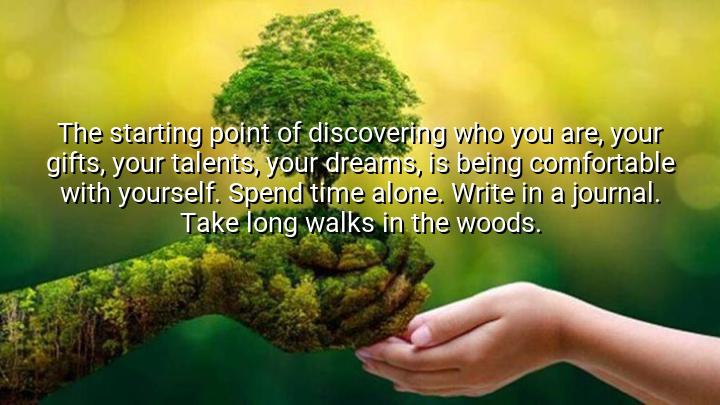




The quote "The starting point of discovering who you are, your gifts, your talents, your dreams, is being comfortable with yourself. Spend time alone. Write in a journal. Take long walks in the woods." by Robin S. Sharma emphasizes the importance of self-awareness and solitude in personal growth. Sharma suggests that in order to truly understand your gifts, talents, and dreams, you must first become comfortable with who you are, and this requires time spent alone. By engaging in activities such as writing in a journal or walking in nature, you create space for reflection and self-discovery.
Sharma’s advice encourages introspection and self-reflection, offering a way to disconnect from the noise of everyday life and reconnect with your inner self. The act of spending time alone, free from distractions, allows you to gain a deeper understanding of your true desires and purpose. He suggests that through solitude, you can more clearly identify what truly matters to you and what you are capable of achieving.
The quote also speaks to the value of stillness and slowing down in a fast-paced world. By taking time to pause, whether through journaling or walking, you give yourself the opportunity to process your thoughts and reflect on your goals without external influence. This process is essential for cultivating a sense of inner peace and understanding, which is crucial for discovering your path in life.
The origin of this quote comes from Robin S. Sharma, a Canadian writer and leadership expert known for his best-selling book The Monk Who Sold His Ferrari. Sharma's teachings often focus on personal development, leadership, and achieving success through inner growth and self-discipline. This quote reflects his belief that personal transformation starts with self-acceptance and the willingness to spend time in solitude, allowing you to discover your true potential.

YNTran yen nhu
This quote highlights simple yet powerful practices for self-discovery. Do you think the act of writing and walking outdoors stimulates introspection more effectively than digital alternatives? How might these habits improve mental health and emotional resilience? I’d like to explore how adopting such rituals could change one’s perspective on life and personal goals.
A8Huynh Vo Lan Anh 8/2
The emphasis on solitude as a starting point raises questions about balance. How much alone time is optimal before it becomes isolating? Are there ways to cultivate comfort with oneself while maintaining meaningful social connections? I’m curious how this advice applies to people with anxiety or those who struggle with loneliness.
LANguyen Lan Anh
This statement resonates with me because it frames self-acceptance as the foundation for uncovering our unique potential. How important is it to disconnect from external distractions to achieve this comfort? Could societal pressures undermine our ability to be alone with ourselves? I’d love to discuss how different cultural attitudes toward solitude impact personal growth.
SMSao Mai
I appreciate the suggestion to write in a journal and take long walks as tools for self-exploration. How do these activities foster comfort with oneself compared to other methods like meditation or therapy? Also, what barriers prevent people from spending time alone, and how can they be overcome? This quote makes me think about the role of quiet reflection in developing creativity and clarity.
NNNhu Ngoc
This quote beautifully emphasizes the importance of solitude in self-discovery. Do you think modern life, with its constant connectivity, makes it harder for people to spend quality time alone? How might journaling and nature walks specifically help us understand our inner selves? I wonder if everyone benefits equally from solitude or if some personalities find it more challenging than others.