

The stars shall fade away, the sun himself Grow dim with age, and nature sink in years, But thou shalt flourish in immortal youth, Unhurt amidst the wars of elements, The wrecks of matter, and the crush of worlds.
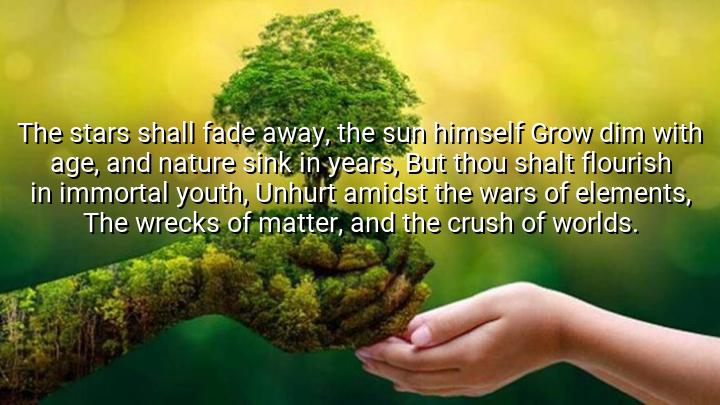




In this quote, Joseph Addison explores the theme of immortality and the enduring nature of the human soul in contrast to the temporary nature of the physical world. He begins by describing how even the most eternal and powerful aspects of the universe, such as the stars and the sun, will eventually fade away with time. He suggests that nature itself will deteriorate and age, alluding to the inevitable decline of the natural world. However, Addison contrasts this inevitable decay with the idea that the soul or spirit can remain immortal and untouched by such changes.
Addison's reference to the human soul flourishing in immortal youth suggests a belief in the eternal vitality of the spirit, regardless of the physical decay of the universe. While the world may fall apart—through the wars of elements, the wrecks of matter, and even the crush of worlds—the soul remains unhurt, continuing to exist in a state of youthful vitality. This reflects Addison’s view of the soul as something permanent, untouched by the destructive forces that affect the material world.
The contrast between the ephemeral nature of physical existence and the eternal nature of the soul is a recurring theme in Addison's work. The quote speaks to the idea that while everything around us may be subject to time and decay, there is something within the human spirit that transcends the mortal realm. This idea reflects a form of spiritual resilience that remains unaffected by the inevitable passage of time and destruction.
Ultimately, Addison’s quote serves as a reminder of the transience of the material world and the timeless nature of the soul. It emphasizes that while the physical universe may deteriorate, there is an enduring part of us that will continue to flourish, unscathed by the ravages of time and cosmic forces. This perspective offers a sense of hope and transcendence, suggesting that true immortality lies not in the physical world, but in the lasting nature of the human spirit.

UGUser Google
Addison’s vision feels almost prophetic—this idea that amid universal destruction, something essential can remain whole. But I wonder, does this reflect a belief in the immortality of the soul? Or is it more symbolic, like saying certain virtues or truths are eternal? In a modern context, can we still believe in anything being truly eternal, or has science and skepticism changed how we view such declarations?
MDDau Minh Dan
Reading this makes me think about the human desire for permanence. Why are we so obsessed with leaving something behind that defies time? Whether it’s through art, love, or legacy, we want to endure. Do you think Addison is affirming that something within us can actually survive the collapse of everything else, or is he simply expressing a hope we all cling to?
ANAnh Ngoc
This is beautiful language, but I feel a little disconnected from it. I wonder—who was Addison writing this for? Is it a religious meditation or a poetic celebration of someone’s legacy? I’m curious how readers of his time would have interpreted this. Would they have seen it as comforting, or maybe even arrogant, to claim something could survive the end of all things?
ANKim Anh Nguyen
I’m moved by the grandeur of this imagery, but I can’t help wondering if it’s overly idealistic. Can anything truly remain untouched by time and chaos? Even ideas evolve, and memories fade. So is Addison being metaphorical, or is this a spiritual assertion? If so, how do we reconcile this eternal optimism with the inevitable decay we witness in the universe and in ourselves?
YAyamane akio
This quote strikes me as both awe-inspiring and mysterious. It almost reads like a tribute to the human soul or perhaps to a divine idea. What exactly is the 'thou' that endures while everything else collapses? Is Addison referencing love, faith, or something more abstract like the spirit of art or virtue? I’d love to hear interpretations of what he believed could outlast even cosmic destruction.