

The soul that sees beauty may sometimes walk alone.
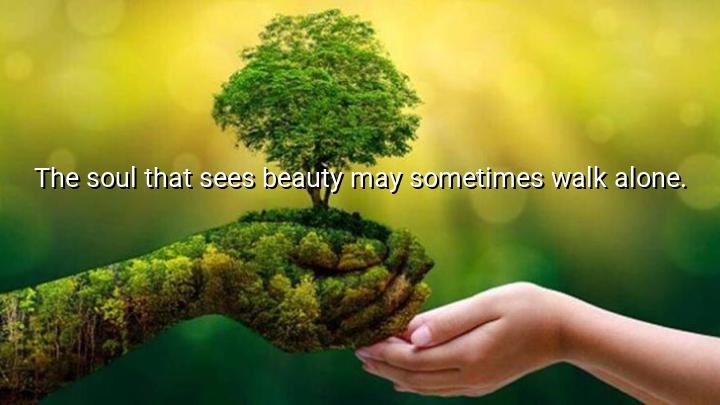




The quote "The soul that sees beauty may sometimes walk alone" by Johann Wolfgang von Goethe reflects on the idea that those who perceive and appreciate beauty in life—whether in art, nature, or human experience—may find themselves isolated because their understanding or perception might not be shared by others. Goethe suggests that such individuals, with their unique sensitivity and vision, may often feel disconnected from the mainstream, walking a path of solitude. However, this loneliness is a natural consequence of being deeply attuned to the aesthetic or spiritual aspects of life.
Johann Wolfgang von Goethe, a German writer, poet, and philosopher, is best known for his works such as Faust and The Sorrows of Young Werther. Throughout his career, Goethe explored the interplay between individual experience and the larger world, often focusing on the tension between personal vision and societal norms. This quote aligns with his larger philosophical themes, emphasizing the value of individualism and the personal journey of those who see the world differently.
The phrase "may sometimes walk alone" speaks to the isolation that can accompany individual thought or creativity. When someone perceives the world in a way that others do not, they might struggle to find companions who understand or appreciate their perspective. While this path may be lonely at times, Goethe implies that it is also noble and worthwhile, as it allows the individual to stay true to their own authenticity and vision.
Ultimately, Goethe’s quote celebrates the strength and beauty of individuality. It encourages those who feel alone in their appreciation for beauty to recognize that their solitude is not a sign of weakness but a sign of their unique ability to see and value what others might overlook. It’s a call to embrace difference and trust in the richness that personal insight can bring, even if it means walking alone.

PHphuong ho
I interpret this quote as a quiet nod to the introvert or the idealist. It resonates with me, but also makes me wonder—can one really appreciate beauty and still feel connected to a noisy, fast-paced world? Is walking alone a choice for peace, or a result of feeling unseen? It’s a powerful reminder that solitude doesn’t always mean sadness—it can also mean clarity and strength.
HMhuyen mt
There’s something deeply moving about this quote. It suggests that seeing beauty might not always be a gift others understand or appreciate. Does this mean that people who perceive the world more intensely are destined to be misunderstood? I’d love to believe that beauty leads to connection, not solitude, but maybe Goethe is pointing out that depth of soul often comes with emotional distance.
YHBao Yen Ha
Goethe’s quote makes me reflect on the nature of visionary or artistic people. Are those who are more attuned to beauty inherently set apart from others? It feels like he’s saying that true perception comes with a cost. But I wonder—can that sense of isolation be softened by finding others with a similar sensibility? Or is walking alone just part of the creative or contemplative life?
TTTranThanh Tinh2008
I love the poetic sadness of this line, but I also question it. Should the ability to see beauty lead someone to walk alone? Or is it that they choose solitude because others can't or won’t see what they do? Is this about emotional solitude or spiritual independence? It’s a beautiful thought, but it raises concerns—how do you find community when your perception sets you apart?
TLTien Le
This quote feels both uplifting and bittersweet. It makes me wonder—why does perceiving beauty often lead to isolation? Is it because those who see the world deeply struggle to relate to those who don’t? I think Goethe is tapping into the loneliness of being sensitive or idealistic in a world that often values speed, convenience, and surface-level interactions. Can beauty be a source of both connection and separation?