

The power of the individual, market forces, and the private sector permeate our lives. With that power comes responsibility to address huge challenges. Climate change cannot be solved by governments alone. Xenophobia, hatred, and intolerance - more business leaders have to play a role in trying to be positive leaders, civic leaders.
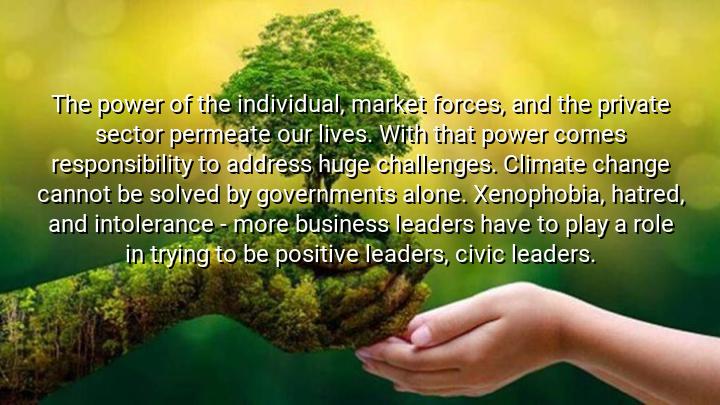




In this quote, Daniel Lubetzky, the founder of the social enterprise Kind Snacks, discusses the significant influence of the individual, market forces, and the private sector in shaping modern society. He acknowledges that these forces permeate every aspect of our lives and come with a responsibility to tackle pressing global issues. Lubetzky highlights that some of the world's most pressing problems, like climate change, cannot be addressed by governments alone; rather, it requires collective action, including that of business leaders and other influential figures.
Lubetzky’s statement emphasizes the idea that with power comes responsibility. He argues that those in positions of influence, particularly in the private sector, should not only focus on profits but also play a more active role in addressing critical societal challenges. His mention of xenophobia, hatred, and intolerance calls for positive leadership from business leaders who have the capacity to promote civic engagement and foster a more inclusive and compassionate society.
The origin of this quote likely stems from Lubetzky’s own experience in building a socially conscious company, where he strives to balance profit with purpose. As someone who advocates for responsible business practices, Lubetzky believes that business leaders should lead by example in addressing global issues and social concerns. His philosophy reflects a growing belief that companies and individuals must contribute to the common good in addition to their financial goals.
In essence, Lubetzky’s quote calls for a shift in the way business leaders approach their roles in society. It stresses that corporate responsibility goes beyond the bottom line and must include active participation in solving societal challenges. By urging business leaders to become positive civic leaders, Lubetzky advocates for a more holistic approach to leadership, where success is measured not just by financial gains but by the impact on the world and its most pressing problems.

HKNgo Hong Khanh
This quote inspires me to consider how the intersection of economic power and social responsibility is evolving. Are younger generations of business leaders more likely to embrace this dual role? What are the barriers preventing more widespread engagement from the private sector in combating hatred and intolerance? I also wonder how small businesses versus multinational corporations differ in their capacity to lead positive change.
Ttram
The idea that climate change and social issues can’t be tackled by governments alone seems especially relevant today. How can individual consumers also play a role in amplifying business responsibility? Does this mean voting with our dollars and supporting companies with strong ethical practices? I’m curious about the role of education and public awareness in empowering both businesses and individuals to act more responsibly in these areas.
TNThao Nguyennn
This statement makes me think about the balance between economic power and ethical leadership. If market forces are so pervasive, should corporate leaders be required by law to address societal challenges? How do we prevent conflicts between profit-driven goals and the need for sustainable, inclusive policies? I’d like to understand better the mechanisms through which business leaders can become effective civic leaders without compromising their company’s financial health.
TLTHuyen Thanh Le
I appreciate the emphasis on shared responsibility, but I question how effectively market forces can address problems like xenophobia and climate change. Can businesses truly lead social change without government regulation? Or is there a risk of superficial efforts—‘greenwashing’ or performative activism—without deep structural commitment? It would be insightful to explore examples where business leadership has genuinely influenced positive social or environmental outcomes.
LNLan Nguyen
This quote really highlights the growing importance of the private sector and individuals in solving global issues like climate change and social intolerance. I wonder how realistic it is to expect business leaders to take on civic responsibilities alongside their profit motives. What incentives or frameworks could encourage more corporate activism? Also, how can consumers hold companies accountable for contributing positively beyond their business interests?