

The picture alone, without the written word, leaves half the story untold.
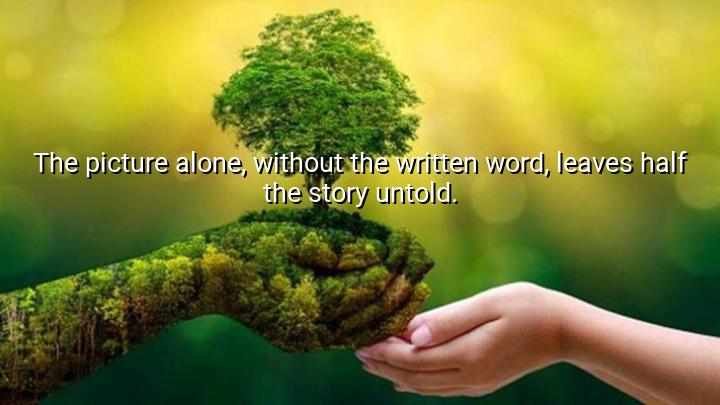




In this quote, James Lafferty emphasizes the idea that a picture, while powerful, does not convey the full depth of a story on its own. He suggests that the written word is essential to complete the narrative, providing context, explanation, and emotion that an image alone cannot fully communicate. A picture captures a moment or a scene, but without accompanying text or narrative, much of the meaning behind it can be left ambiguous or incomplete.
Lafferty’s statement reflects the belief that visual media, such as pictures, can evoke powerful emotions and convey information, but they often lack the clarity and detail that words can provide. The written word offers structure, backstory, and insight into the intentions, motivations, and consequences of the depicted scene. Together, the image and the text form a more comprehensive and nuanced understanding of the story being told.
This quote also speaks to the relationship between visual and verbal communication. In many forms of storytelling, whether in books, films, or journalism, both images and words work together to convey the intended message. Lafferty implies that relying solely on one medium—be it visual or written—may lead to an incomplete or limited interpretation of the full narrative.
Ultimately, Lafferty highlights the importance of balance between images and words in telling a complete story. While a picture can be impactful, the written word provides the necessary depth and detail to ensure that the audience fully grasps the meaning and significance behind the image.

HLHien Le
I find this quote intriguing, especially when thinking about art. Sometimes a painting speaks volumes without a single word, but even then, an artist’s intent or historical background can completely shift our understanding. So is it true that visuals are inherently incomplete? Or do they just invite a different kind of interpretation? Maybe the real power lies in pairing the two—image and word—to create something truly resonant.
TLMy Na Tran Le
This quote got me thinking about journalism and the ethics of photojournalism. A shocking image can provoke outrage or sympathy, but without written context, it can also mislead. Who decides what the audience knows beyond the image? Lafferty’s point feels like a plea for depth and responsibility in storytelling. Are we training ourselves to look past the surface and ask for more context in everything we consume?
LTLuan Trieu
I love the artistic tension in this quote—it almost feels like a defense of language itself. While a picture might show emotion or setting, it can’t always express nuance, motivation, or inner thoughts. Are we losing something important by focusing so heavily on visual culture? I think Lafferty is reminding us that the written word isn’t outdated—it’s the other half of a whole experience.
S1Dang Thi Thao Truong THPT Tan Yen so 1
This quote resonates in an age of social media, where images are often posted without explanation. How many times have we made assumptions about someone’s life or situation based on a single photo? It makes me wonder—how many stories are being misunderstood or oversimplified because they’re missing the written word? Maybe we need to slow down and ask: what’s the unseen story here?
NTY Nhi Nguyen Tran
Lafferty’s insight makes me think about how crucial storytelling is to human understanding. A powerful image might grab our attention, but without written context, we might miss the intention or even misinterpret it completely. Can we truly understand a moment frozen in time without the narrative behind it? It reminds me that writing and imagery should work together—not compete—to deliver a fuller message.