

The person who tries to live alone will not succeed as a human being. His heart withers if it does not answer another heart. His mind shrinks away if he hears only the echoes of his own thoughts and finds no other inspiration.
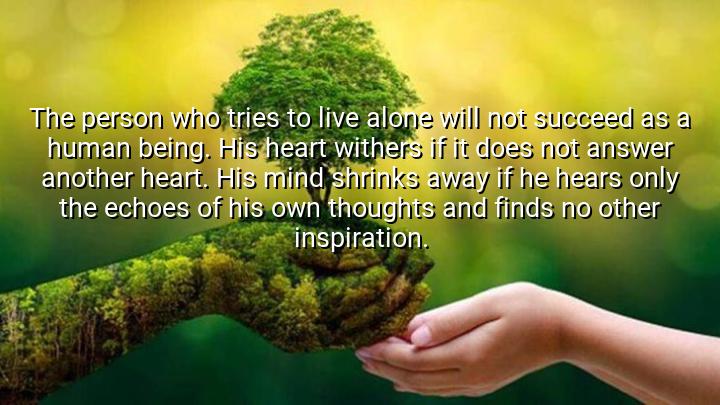




The quote, "The person who tries to live alone will not succeed as a human being. His heart withers if it does not answer another heart. His mind shrinks away if he hears only the echoes of his own thoughts and finds no other inspiration," is from Pearl S. Buck, an American writer and Nobel Prize laureate. In this statement, Buck emphasizes the importance of connection and interaction with others in the development of a person’s emotional and intellectual well-being.
Buck suggests that living in isolation leads to a shrinking of both the heart and the mind. Without meaningful connections to others, a person's emotional capacity diminishes, and their ability to grow intellectually is stunted. She implies that human beings are inherently social creatures, and it is through relationships and engagement with others that we find emotional fulfillment and inspiration for personal growth.
The phrase "His heart withers if it does not answer another heart" illustrates the emotional aspect of human connection. Buck believes that we cannot thrive emotionally if we do not share and respond to the feelings of others. Similarly, the mind needs external stimuli and diverse perspectives to stay vibrant and creative. Buck warns that without these influences, a person’s thoughts become repetitive and lacking in depth.
Ultimately, Buck’s quote highlights the necessity of community and human interaction for a fulfilling life. She suggests that personal growth—both emotional and intellectual—depends on our ability to connect with others and draw inspiration from the world beyond ourselves. The message is a reminder of the interdependence of people and the value of shared experiences in the journey toward becoming a complete human being.

8TPhuong 8A Thao
I’m curious how this idea applies to modern life, especially with the rise of digital communication. Can virtual connections satisfy the heart’s need for response and the mind’s need for inspiration? Or do they risk becoming mere ‘echoes’ of our own thoughts? How can we cultivate genuine connection in an increasingly digital world?
HVHoang Viett
Emotionally, this quote speaks to the pain of isolation and the vitality of relationships. How can we foster deeper, more meaningful connections to prevent the heart and mind from withering? What role do empathy and communication play in sustaining human flourishing? Could technology help or hinder this process?
SNSelaris Ngo
Reading this, I wonder about people who choose solitude for spiritual or personal reasons. Can intentional solitude fulfill the heart and mind’s needs differently than loneliness? How do practices like meditation or retreat balance isolation with the need for connection? Could this quote be a caution against unhealthy isolation rather than all alone time?
LKLien Kim
I find the idea that the mind ‘shrinks away’ without external inspiration compelling. How important is dialogue and diverse perspectives in expanding our thinking? Does this suggest that learning and creativity require constant interaction with others? How might this impact educational and professional environments?
TTVo Thi Thu Tram
This quote makes me reflect on the balance between independence and interdependence. Can someone truly thrive if they isolate themselves, or is community essential to becoming fully human? How do cultural differences influence this need for connection? Are there societies that value solitude more, and how do they mitigate the risks Buck mentions?