

The people, and the people alone, are the motive force in the making of world history.
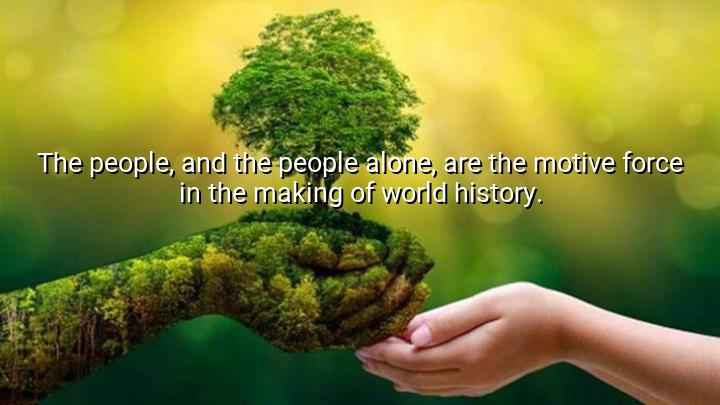




The quote "The people, and the people alone, are the motive force in the making of world history" by Mao Zedong emphasizes the central role of the masses in shaping historical events and societal change. Mao argues that it is not the actions of elites, governments, or powerful individuals alone that influence history, but rather the collective efforts and actions of ordinary people. This perspective challenges the traditional view that history is driven by a few influential figures and instead highlights the power of popular movements in transforming the world.
Mao Zedong, the founding father of the People's Republic of China, was a key figure in the Chinese Communist Party and led the country through significant political, social, and economic changes. His leadership during the Chinese Revolution and the establishment of the communist state were rooted in the belief that revolutionary action by the people could overthrow oppressive systems. This quote reflects Mao’s deep conviction in Marxist theory, which sees the working class and peasantry as the true drivers of historical progress.
The phrase "the people alone" highlights Mao’s belief in the sovereignty of the masses and their ability to bring about change through collective action. It underscores the idea that the common people—workers, peasants, and the general population—hold the ultimate power to create lasting historical shifts, rather than relying on the dictates of ruling elites. Mao’s statement reinforces the importance of popular revolution as a means to challenge oppressive systems.
Ultimately, Mao’s quote calls for empowerment and action from the people. It encourages a focus on grassroots movements and collective effort as the true source of social change and historical transformation. This perspective reinforces the idea that history is shaped not only by individual leaders but by the will and struggles of the masses who fight for their rights and a better future.

NNNguyen Ngoc
This quote seems to affirm the importance of collective human effort, which I admire. But I wonder—can it also unintentionally diminish individual contributions? Thinkers, artists, innovators—don’t they also shape the course of history in powerful ways? Is there a danger in viewing history too broadly, where the nuances of individual action get lost under the banner of 'the people'?
NAngoc anh
Mao’s quote makes me reflect on the nature of historical narratives. So often, history is written through the lens of great leaders, yet this suggests that real momentum comes from the ground up. But is this idealistic? What about the systems and institutions that suppress popular movements? Do we overestimate the agency of ‘the people’ when structural barriers are so deeply entrenched?
NVnguyen vy
It’s a compelling thought—that collective will is the engine of historical change. But I worry it can also romanticize mass movements without considering their complexity. Not all 'people-driven' events are positive or progressive. How do we navigate the tension between the power of the masses and the potential for that power to be manipulated, misdirected, or even destructive?
NLChi Le nguyen linh
This quote immediately made me think about modern social movements and grassroots activism. It echoes in today’s protests and uprisings. But I wonder—do we still believe this as a society, or has power become so concentrated that 'the people' are more symbolic than influential? With governments and corporations holding so much control, can ordinary citizens still be a decisive force in shaping history?
NPle nguyen phuong
There’s something empowering about this statement—it shifts the focus of history away from rulers and onto the masses. But it also raises a question: how do we define ‘the people’? Is it truly everyone, or does it often exclude marginalized voices? I’d be curious to explore how this idea aligns with movements across history, from revolutions to civil rights. Who really drives change, and who gets credited for it?