

The longer one is alone, the easier it is to hear the song of the earth.
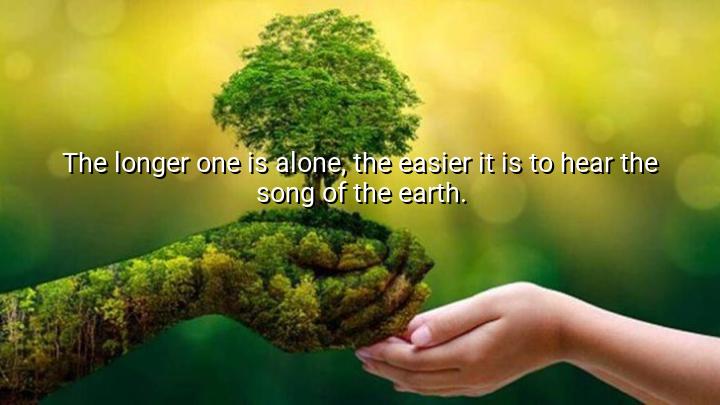




The quote "The longer one is alone, the easier it is to hear the song of the earth" by Robert Anton Wilson reflects a deep appreciation for solitude as a pathway to awareness, connection, and inner peace. Wilson suggests that when we remove ourselves from the distractions of society and embrace aloneness, we begin to perceive the subtle rhythms of nature and the world around us—what he poetically calls the "song of the earth."
Robert Anton Wilson was an American writer, futurist, and philosopher known for his explorations of consciousness, alternative realities, and human perception. His work often challenged conventional thought and embraced both scientific skepticism and spiritual possibility. This quote aligns with his broader belief that deeper truths and experiences lie beyond the surface of daily life and are best accessed through quiet, reflection, and expanded awareness.
The phrase "song of the earth" is symbolic of the natural harmony and wisdom that can be felt when one is still—something often drowned out by the noise of modern life. In solitude, the mind becomes quieter, and a person becomes more attuned to the present moment, to nature, and to the interconnectedness of all things. This “song” represents more than just sounds of birds or wind—it refers to a spiritual resonance or universal rhythm that solitude helps us hear.
Ultimately, Wilson's quote celebrates solitude not as a state of lack, but as a rich opportunity for deep listening and reconnection. It reminds us that by stepping away from the rush of society, we open ourselves to experiencing the mystery, beauty, and depth of the world—and of ourselves—in a more profound way.

NTHuong Nguyen Thi
As someone who’s always lived in cities, this quote makes me long for silence — not just quiet, but real stillness. I wonder if solitude out in nature holds a different kind of magic than solitude indoors. Does the environment you’re alone in matter? Maybe that’s the deeper point here: that solitude isn’t just about being away from people, but being present with the earth itself.
CPChien Pham
This quote gives off a deeply spiritual vibe, and I can’t help but wonder if prolonged solitude is a kind of tuning fork for the soul. But is there a risk to it too? Can too much time alone blur the line between peace and isolation? Where do we draw the line between spiritual solitude and social withdrawal, especially for those who find modern life overwhelming?
NNNuong Nuong
This makes me think about how overstimulation dulls our senses. In solitude, there’s room to notice the subtle things — wind in the trees, birdsong, even the silence itself. But have we trained ourselves out of that sensitivity? With so much digital distraction, do we even remember how to truly listen to the world around us? Maybe solitude isn’t just a luxury anymore — maybe it’s a necessity.
KTKhanh Tran
There's something both comforting and mystical about this quote. But it raises a question: is this connection to the earth accessible to everyone, or does it require a certain mindset? Some people fear being alone, while others find it awakening. What factors determine whether solitude becomes an escape or an entryway to deeper truths? I wonder if cultural upbringing plays a role in how we experience this connection.
ISImono sakura
I love the imagery in this quote — it’s almost meditative. It makes me wonder: in a constantly connected world, have we forgotten how to listen to the earth? Maybe solitude doesn’t just offer personal clarity, but also restores our relationship with nature. Is this why people feel more peaceful after spending time alone in forests or by the ocean? Could solitude be essential for environmental empathy?