

The lonely become either thoughtful or empty.
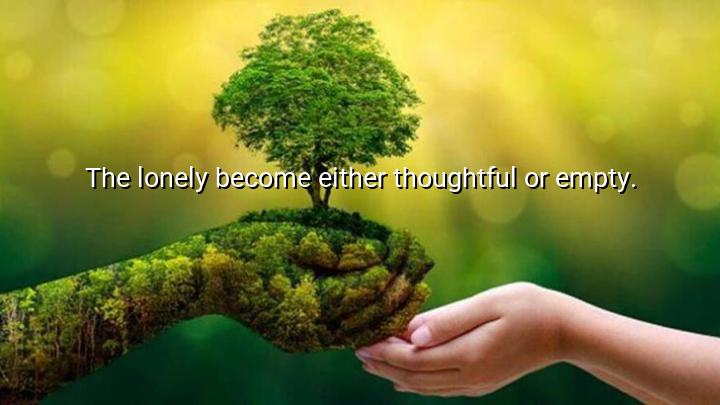




The quote "The lonely become either thoughtful or empty" by Mason Cooley explores the profound impact that loneliness can have on the human mind and spirit. Cooley suggests that loneliness is a powerful emotional state that can lead people down one of two very different paths: deep reflection or emotional hollowness. In other words, time spent alone can either nurture introspection and personal growth, or result in a sense of emptiness and despair, depending on how one chooses to engage with that solitude.
Mason Cooley was an American aphorist known for his concise and insightful observations about human behavior, society, and emotion. His aphorisms often reflect a mix of wit, clarity, and philosophical depth, and this quote fits well within that tradition. In just a few words, he captures the psychological fork in the road that loneliness can present to a person—either using it as a space for contemplation or falling into emotional disconnection.
The contrast between "thoughtful" and "empty" speaks to the choices we make in how we respond to solitude. When faced with isolation, some people turn inward in a meaningful way, examining their values, emotions, and goals, becoming wiser in the process. Others may feel overwhelmed by the silence and absence of connection, resulting in a kind of numbness or lack of purpose. This duality shows that loneliness, while difficult, is not inherently negative—it depends on how it's processed.
Ultimately, Cooley’s quote is a reflection on emotional resilience and self-awareness. It reminds us that we have some degree of control over how we experience and respond to lonely moments. With the right mindset, loneliness can become a catalyst for insight, but without intention or support, it can also erode our sense of meaning.

GNLe Gia Nhu
Is this quote suggesting that loneliness is inherently transformative, for better or worse? If that’s true, does that mean we should be paying more attention to how we support people in isolation? Maybe loneliness is like pressure — it can create diamonds or crush you. I’m wondering if interventions like journaling, therapy, or art could help tilt the outcome toward thoughtfulness rather than emotional void.
AADMIN
This quote hits home for anyone who’s experienced long periods of solitude. But is it fair to say the outcome is binary? Can’t someone fluctuate between being thoughtful and feeling empty, even in the same hour? I think this highlights the emotional volatility of loneliness. It’s not a static state — it’s dynamic, unpredictable. What do we need — emotionally or socially — to navigate that flux more safely?
CNnguyen cong nam
I’ve often wondered how much of our personal growth is rooted in lonely moments. This quote suggests that isolation can be a catalyst for deep thought — but also a danger zone for emotional numbness. What determines which way it goes? Is it tied to purpose, past trauma, or even how we’re taught to cope? I’d love to hear if others believe solitude has been more constructive or destructive in their own lives.
CLCam Le
There’s something haunting about this statement. It seems to suggest that loneliness isn’t neutral — it pushes us toward something, either internal depth or a kind of inner void. But is it always that extreme? Isn’t there also a space in between, where someone can feel lonely without becoming entirely reflective or entirely empty? I wonder if this quote over-simplifies what is actually a very nuanced human experience.
GLHoang Gia Linh
This quote really got me thinking — is it implying that loneliness is a kind of crossroads? That we either sink deeper into despair or rise into introspection? I’m curious whether the outcome depends more on personality, support systems, or life context. What makes one person find clarity and creativity in solitude, while another feels hollow and defeated? Could it be as much about mindset as it is about circumstance?