

The law was made for one thing alone, for the exploitation of those who don't understand it, or are prevented by naked misery from obeying it.
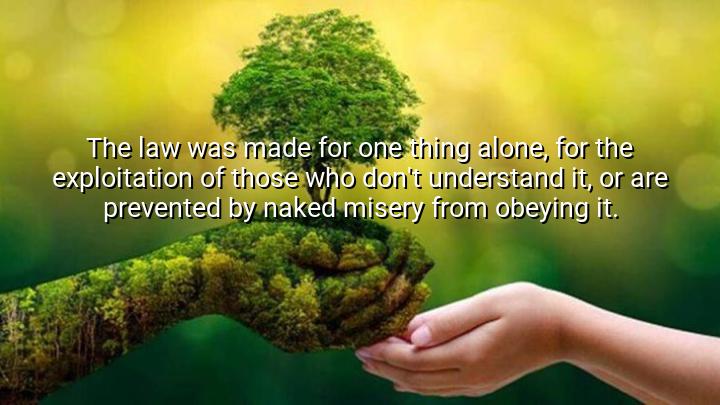




In this quote, Bertolt Brecht, a German playwright and poet, critiques the law and its role in society. He suggests that the primary function of the law is not to ensure justice or equality, but rather to exploit those who either cannot comprehend it or are unable to follow it due to extreme poverty or misery. Brecht argues that the legal system often serves the interests of the powerful while leaving the poor and marginalized at a disadvantage. For those who are suffering from economic hardship, the law becomes an obstacle they cannot overcome, and thus, they are penalized for their inability to comply.
Brecht’s statement reflects his Marxist perspective, where he believed that the law was inherently biased in favor of the ruling class. According to this view, the legal system is designed in such a way that it benefits the elite who have the resources and knowledge to navigate it, while it burdens the working class or impoverished individuals who are more likely to face legal consequences due to their lack of access to legal resources or education. The ignorance of the law or the inability to follow it due to economic distress thus becomes a form of social control.
This critique of the law also ties into Brecht’s broader body of work, which often explored themes of inequality, oppression, and exploitation. He believed that societal structures, including the legal system, were designed to maintain the status quo and preserve the power of those at the top. By highlighting how the law disproportionately impacts the vulnerable, Brecht challenges the fairness and equity of such systems.
Ultimately, Brecht’s quote calls for a reexamination of how laws are created and enforced. It suggests that instead of being a tool for justice, the law often serves to reinforce social inequalities, making it difficult for the most disadvantaged to live within the legal framework. His words advocate for a more equitable system, where the law is not a mechanism for exploitation but a means of protecting all members of society, regardless of their social or economic status.

MNmai Nguyen
This quote makes me reflect on the relationship between knowledge and power. If the law is truly used to exploit those who don’t understand it, then isn’t legal education one of the most important tools for empowerment? I’m curious what others think—should legal literacy be a basic part of public education? If everyone understood the law better, would it still serve the same interests?
NDNgoc Dang
I think Brecht’s perspective is intentionally radical to spark discomfort, and it works. But I wonder—does saying the law was made solely for exploitation ignore the efforts of legal reformers and activists who’ve fought to make it fairer? Yes, there are serious flaws, but isn't there also a legacy of progress within the legal system? Maybe the quote is a call to wake up rather than give up.
MNLuong Thi Minh Nguyet
This statement is haunting because it frames the law not as a safeguard but as a weapon. I get the frustration, especially when you look at how poverty intersects with incarceration or debt. But is there any hope for reform within such a bleak framework? Can the law ever be reshaped to protect the vulnerable rather than punish them? Or is its structure too deeply rooted in inequality to change?
PAPham Phuong Anh
I find this quote unsettling but also deeply thought-provoking. It forces us to ask who the law actually serves. Is justice really blind, or does it tip toward those with money, education, and power? I wonder how much of the legal system is truly accessible to the average person. If people don’t understand the law or can’t afford to follow it, can it still be considered just at all?
HNHoang Hong Nhung
This quote feels incredibly provocative and cynical, but I can’t help wondering—how much truth is there in it? Are laws inherently unjust, or is it the way they're enforced that causes harm? Brecht seems to argue that laws serve the powerful, but isn’t that an overgeneralization? I agree that people in poverty often face legal systems differently, but does that mean all law is built for exploitation?