

The foolish and the dead alone never change their opinions.
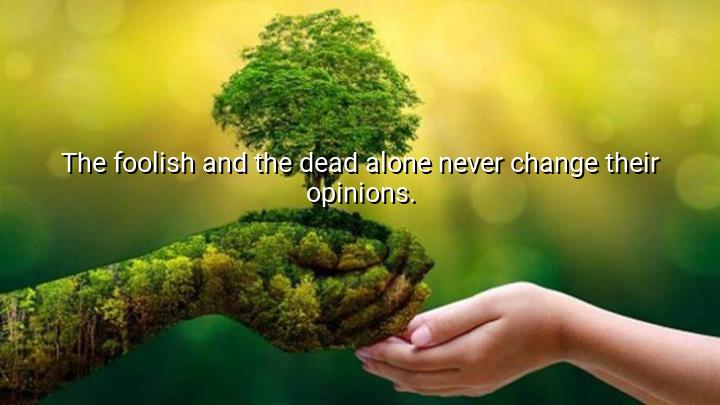




In this quote, James Russell Lowell, an American poet and critic, suggests that change and growth are essential aspects of human nature, and that the ability to change one's opinions is a sign of life and intelligence. He contrasts the foolish and the dead—who remain stagnant in their views—with those who are open to reflection, learning, and evolution in their thinking. For Lowell, the foolish are those who are close-minded and unwilling to reconsider their opinions, while the dead represent those who can no longer engage in thought or change at all.
The quote highlights the idea that flexibility and openness are key to intellectual and personal development. People who can change their opinions based on new information or experiences are, in Lowell's view, more alive—in both a literal and figurative sense—than those who remain rigid in their beliefs. This aligns with a growth mindset, where individuals embrace the possibility of change and improvement, continuously evolving based on knowledge and insight.
Lowell’s statement also serves as a critique of stubbornness and dogmatism. He suggests that when people refuse to change their minds, whether out of pride or ignorance, they are essentially hindering their own progress and understanding. In contrast, the capacity to reconsider one's opinions is seen as a sign of wisdom, self-awareness, and a willingness to engage with the world in a meaningful way.
Ultimately, Lowell’s quote encourages us to embrace the process of self-reflection and learning. It reminds us that growth comes from being willing to adapt, revise our opinions, and challenge our assumptions. By doing so, we not only become more open-minded but also more connected to the evolving nature of the world around us.

APNhut anh Phan
This statement makes me think about how ego ties into our beliefs. Sometimes holding onto an outdated opinion is more about pride than principle. Have you ever stuck to a viewpoint just to avoid admitting you were wrong? I definitely have. It makes me wonder—how do we unlearn the idea that being wrong is shameful, and instead embrace it as a step toward wisdom?
NHnguyen huyen
This quote sparks a question in me—how do we foster environments where people feel safe enough to change their minds? Whether it's on social media or in personal relationships, there seems to be this fear of being seen as wrong or inconsistent. But if we want to grow, don’t we need to make space for dialogue and revision? How can we normalize the idea that it’s okay to change?
MTtruong nu my tien
I’m torn on this one. While I agree that growth often requires a shift in perspective, I’ve also seen people criticized unfairly for 'flip-flopping.' Why do we penalize politicians, public figures, or even friends when they evolve? Isn’t adapting to new facts or experiences a sign of maturity? Maybe the issue isn’t changing opinions but being transparent and thoughtful about why we do.
MVDo Bui Minh Vy
This quote really challenges my idea of what strength looks like. We often celebrate people who are 'unshakable' or 'principled,' but what if that’s just another word for being rigid? Is there such a thing as being too principled? I think it’s worth asking whether refusing to change is always noble—or sometimes just stubbornness disguised as integrity.
PTPhuong Truong
I love how brutally honest this quote is. But it also makes me wonder—how do we distinguish between healthy change and being too easily swayed? There’s a fine line between being open-minded and being unanchored. I think the challenge lies in learning when to hold firm and when to let go. What tools or habits help people tell the difference between thoughtful evolution and inconsistency?