

The doer alone learneth.
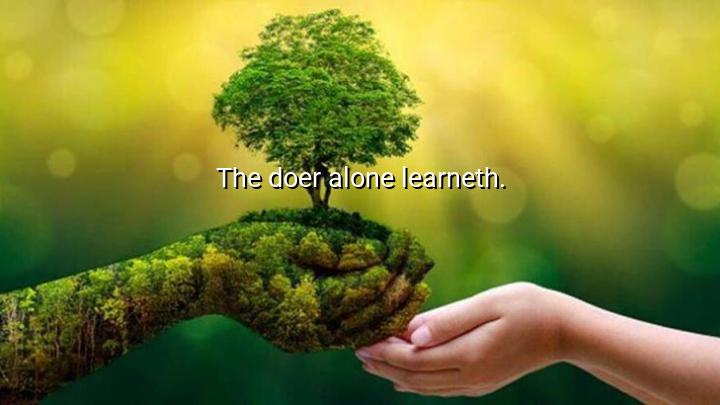




The quote "The doer alone learneth" by Friedrich Nietzsche emphasizes the idea that true knowledge and understanding come through action and experience, not just theoretical learning or intellectual study. Nietzsche suggests that it is only by actively engaging in the world and doing something that one gains real insight and personal growth. This perspective challenges the notion that learning is solely a matter of passive observation or abstract thinking, highlighting the importance of practical and experiential knowledge.
Friedrich Nietzsche, a German philosopher known for his radical ideas and critique of traditional values, often focused on the themes of individualism, self-overcoming, and the rejection of societal norms. This quote reflects Nietzsche's belief in the importance of self-exploration and the development of personal strength through action. According to Nietzsche, it is not enough to simply acquire knowledge from books or teachings; one must act in the world to truly understand life and develop one's character.
The phrase "the doer alone learneth" suggests that learning is an active process that requires engagement, risk, and responsibility. It underscores the notion that true mastery comes from doing rather than merely studying or contemplating. Nietzsche believed that action—whether it’s taking risks, making mistakes, or challenging oneself—is where real wisdom is gained. This concept ties into his broader philosophy of becoming one's authentic self through personal experience and action.
Ultimately, Nietzsche’s quote serves as a reminder that growth and learning are not passive but require initiative and the willingness to experience life firsthand. It challenges the idea of knowledge as something to be acquired from external sources alone, urging individuals to take responsibility for their own development by immersing themselves in real-world experience and action. Through this, they not only gain knowledge but also cultivate a deeper understanding of themselves and the world around them.

CDKhanh Chi Do
Is this quote dismissing all forms of passive learning—or is it simply emphasizing that true transformation happens through action? I think about people who study endlessly but hesitate to apply what they know. Does that make their knowledge hollow? Nietzsche seems to be advocating for a kind of embodied learning where ideas aren’t real until they’re tested. But does that mean reflection without action is pointless?
KNKim Ngan
This quote feels incredibly motivating, almost like a challenge. It makes me reflect: how often do I stay in the comfort of planning and overthinking instead of actually doing? Is Nietzsche trying to shake us out of paralysis and remind us that real growth is messy, uncertain, and active? I wonder how different my personal development would look if I spent more time acting instead of analyzing.
TTr$ng
I admire Nietzsche’s emphasis on action, but doesn’t this risk undervaluing the insights gained through observation and introspection? Some of the greatest thinkers in history spent years in study and solitude. Can someone not be a learner unless they are also a doer? Or is he pointing more to a different kind of wisdom—one that only surfaces through lived experience and embodied understanding?
QNQuynh Nguyen
This quote really makes me question the structure of modern education. If action is the only real teacher, are we focusing too much on abstract learning and not enough on real-world application? How much can one actually learn sitting in a classroom or behind a screen if they never step into practice? Maybe it’s a wake-up call to rethink how we bridge theory with hands-on experience.
NANguyet Anh
Nietzsche’s statement hits hard—especially in a world full of passive consumption. Is he saying that reflection, observation, or study don’t truly teach us unless they're followed by action? I’ve always believed there’s value in learning through reading and contemplation, but maybe that kind of knowledge is incomplete. Could it be that only through doing—through experience, trial, and even failure—do we internalize truth in a lasting way?