

The artist alone sees spirits. But after he has told of their appearing to him, everybody sees them.
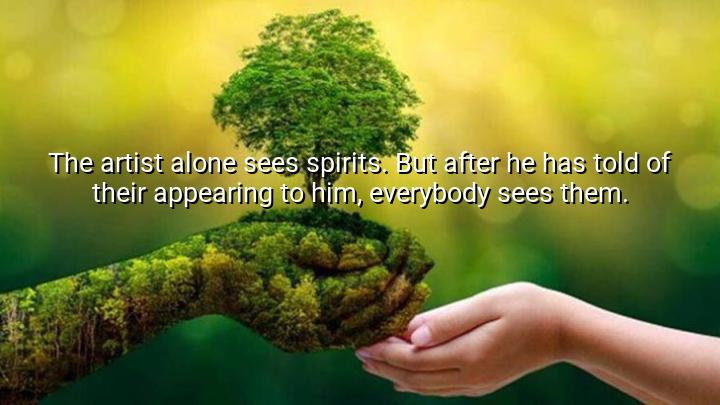




The quote "The artist alone sees spirits. But after he has told of their appearing to him, everybody sees them." by Johann Wolfgang von Goethe explores the unique role of the artist in perceiving and interpreting the world in ways that others cannot. Goethe, a renowned German writer and thinker, suggests that artists possess a unique vision or insight, allowing them to perceive things that are invisible to the average person—symbolized by the spirits. These spirits represent ideas, emotions, or truths that are often abstract and beyond the comprehension of ordinary experience.
The second part of the quote, "But after he has told of their appearing to him, everybody sees them," reflects the transformative power of art. Once the artist shares their vision—through painting, writing, music, or other forms of expression—the audience begins to see the world in a new light, interpreting the artist’s insights as their own. The artist brings to light concepts or emotions that others may not have fully realized, and through the artist’s work, the invisible becomes visible to a broader audience. This underscores the artist's role as a visionary who, through creativity, can shift collective perception.
Goethe’s words also highlight the subjectivity of artistic experience. The artist’s perception of the world is personal, but once expressed, it can resonate with others, expanding their understanding and leading them to see what the artist has seen. This speaks to the power of art to transcend individual experience and touch the universal human condition, offering others the opportunity to connect with and appreciate perspectives they might not have considered.
Ultimately, Goethe’s quote elevates the artist’s role as someone who brings forth new realities and insights that others might not have access to on their own. It emphasizes that the artistic process is one of revelation, where imagination and creativity give way to shared experiences that can shape and change societal perceptions. Through their work, artists make the invisible visible, inviting everyone to partake in a new, expanded view of the world.

D105-Nguyen Thanh Dat- 12A5
This makes me consider how art shapes our collective imagination and shared reality. Once the artist reveals these visions, they become part of the cultural fabric, influencing how people see the world. How might this process affect identity, memory, and values within a society? It’s a powerful reminder of art’s role in constructing meaning.
KVPham Thi Kieu Vi
I’m curious about the nature of these ‘spirits’—are they literal supernatural beings, emotions, ideas, or cultural symbols? The ambiguity invites multiple interpretations, making the quote rich and layered. How does this flexibility reflect the diversity of artistic expression and its impact on different audiences?
TVNguyen Hoang Thanh Vy
This quote prompts me to think about the responsibility artists carry. If they reveal unseen ‘spirits’ or truths, how does that influence society and culture? Can art challenge prevailing norms and inspire change by making the invisible visible? It also raises questions about authenticity and how much an artist’s vision is personal versus universal.
ANThien An Nguyen
Could this statement be a metaphor for how innovation and new ideas spread? The artist ‘sees’ something first, and through sharing, others come to recognize it too. How might this apply beyond art, to science or philosophy? It highlights the importance of communication and storytelling in shaping collective perception and knowledge.
HBHue Bui
I’m fascinated by the idea that only the artist initially ‘sees spirits,’ implying a special sensitivity or insight. Does this mean that art can reveal deeper truths or hidden realities? It also makes me think about how audiences participate in this process—once introduced, do they genuinely perceive new things, or is it more about suggestion and interpretation? This quote invites reflection on the relationship between creator and viewer.