

Still and all, why bother? Here's my answer. Many people need desperately to receive this message: I feel and think much as you do, care about many of the things you care about, although most people do not care about them. You are not alone.
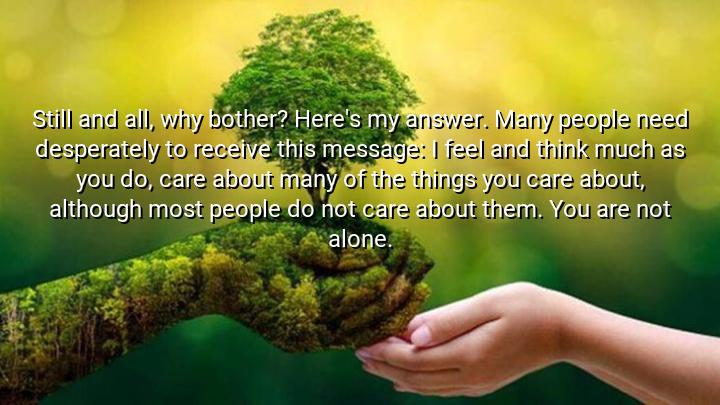




The quote "Still and all, why bother? Here's my answer. Many people need desperately to receive this message: I feel and think much as you do, care about many of the things you care about, although most people do not care about them. You are not alone." by Kurt Vonnegut reflects his deep concern with human connection and the shared emotional experiences that often go unspoken. Vonnegut responds to the existential question “why bother?” with a compassionate and affirming answer: people need to hear that they are understood and not as isolated as they may feel.
Kurt Vonnegut, a celebrated American author known for works like Slaughterhouse-Five and Cat’s Cradle, frequently explored themes of loneliness, absurdity, and meaning in the modern world. This quote comes from the preface to his book Timequake, where he reflects on his reasons for continuing to write. He believes that even when the world feels indifferent, offering empathy and recognition to others gives life purpose.
The message at the heart of this quote—“You are not alone”—is both simple and powerful. It acknowledges that many people feel misunderstood, invisible, or disconnected from the larger society. Vonnegut reassures them that someone else shares their thoughts and values, even if the majority does not. This small act of solidarity can be profoundly healing for those struggling to find a sense of belonging.
Ultimately, Vonnegut’s words are a reminder of the moral purpose of storytelling: to remind others that their feelings matter and that connection is possible, even in a fragmented world. In saying, “I feel and think much as you do,” he bridges the gap between individuals, turning solitude into understanding and compassion.

MANguyen Minh Anh
There’s a deep kindness embedded in this quote. Vonnegut’s words suggest that writing, or even just being human, isn’t about being clever—it’s about connection. But it also makes me wonder, who decides what messages are worth repeating? Are we doing enough to share the thoughts and feelings that might bring someone else peace? This quote reminds me that meaning doesn’t always come from answers, but from presence.
TTThuan Tran
Vonnegut's quote resonates with me as both comforting and challenging. It’s comforting because it reminds us that someone, somewhere, understands. But it’s challenging because it places a quiet responsibility on us to reach out, to speak up, to say, 'I see you.' I wonder how often we underestimate the impact of simply expressing that we relate. Can small moments of honesty be revolutionary in a world full of noise and pretense?
TTtran thuy
This feels like a quote that someone would whisper to you in the middle of a breakdown, when you feel most invisible. I love that Vonnegut doesn’t shy away from the existential dread—he answers it with connection. But here’s my question: how many of us are brave enough to share our inner thoughts like this, to be vulnerable in a way that could actually make someone else feel seen?
KCAnh Kunn Chu
What I find powerful here is the humility in Vonnegut’s reasoning—he’s not trying to change the world, just remind someone they’re seen. That’s rare. But it also makes me ask: is this kind of empathy enough to make people feel less alone, or do we need action too? Can shared feelings bridge the growing social and emotional gaps we’re seeing everywhere? Or does it remain just a beautiful sentiment without follow-through?
UGUser Google
This quote hits like a lifeline thrown across a dark sea. It makes me think about how often people feel isolated—not because they're physically alone, but because they believe no one else shares their values or inner world. Vonnegut’s message is so simple, yet so profound. But I wonder: in a world that seems increasingly divided, how do we keep delivering this message to people who need it the most?