

Sometimes I think we're alone in the universe, and sometimes I think we're not. In either case the idea is quite staggering.
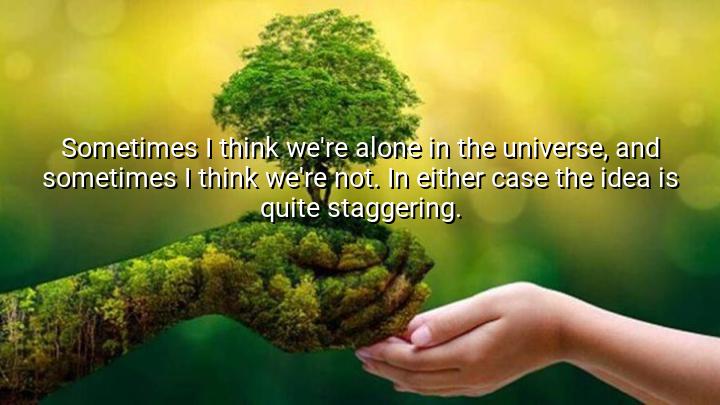




In this quote, Arthur C. Clarke explores the vast and humbling possibilities regarding human existence in the universe. He begins by reflecting on the idea that sometimes we're alone in the universe, implying the possibility that Earth is the only planet capable of sustaining life, and humans are the sole sentient beings in the vastness of space. This thought is staggering in its own right, as it suggests a profound isolation in the universe, where human beings would be unique and perhaps entirely self-reliant.
On the other hand, Clarke also entertains the idea that we're not alone, suggesting the possibility that other forms of life, perhaps far more advanced or different from our own, exist elsewhere in the universe. The sheer idea of encountering extraterrestrial life or realizing that life is abundant beyond our planet is also staggering in its implications. This raises profound questions about the nature of life, our place in the cosmos, and the potential for discovery or even contact with other civilizations.
Clarke’s quote is a reflection on the scale and mystery of the universe. He captures the duality of the human experience: the loneliness of contemplating an empty, vast cosmos versus the awe and excitement of discovering that life might exist beyond Earth. In both cases, the enormity of the possibilities is overwhelming, and Clarke suggests that contemplating either scenario forces humanity to confront its own significance or insignificance in the greater cosmic context.
Ultimately, the quote conveys a sense of wonder and mystery, inviting reflection on both the physical and philosophical dimensions of existence. Clarke’s words remind us that whether we are alone or not in the universe, the idea itself is a staggering realization that challenges our understanding of life, science, and the future of human exploration.

BDNguyen Ba Duong
Every time I read this, it reminds me how little we truly understand. Whether we are a cosmic accident or part of a much larger web of life, the implications are enormous. How would our worldviews, religions, and cultures adapt if we confirmed alien life? Or if we proved we’re the only intelligent beings in the universe? Either revelation would shake the foundation of our collective identity in profound ways.
CHmai chi hieu
I’ve always loved this quote because it touches something primal in us—the need to belong, and the fear of the unknown. Why is it so hard to accept either possibility with peace? Is it because both scenarios force us to confront the limits of our knowledge, and even our significance? I’d love to know if philosophers or theologians have different takes on this compared to scientists or astronomers.
THBui Thu Hien
This quote makes me question our assumptions about intelligence and existence. If we're not alone, would other civilizations be more evolved or completely different in how they think and live? And if we are alone, then shouldn't we treat life on Earth with even more reverence and responsibility? It’s staggering to think either way. Clarke was ahead of his time in how he framed this dual mystery with such elegance.
LADang Luu Anh
It’s wild to think how this quote has only become more relevant with time. We’ve discovered so many potentially habitable exoplanets, yet we still have no evidence of life beyond Earth. Why is that? Is the universe just too vast for us to find each other, or are we truly alone? Clarke’s words perfectly capture the existential weight of that uncertainty. How would discovering alien life redefine what it means to be human?
MCTue Minh Cao
I find this quote incredibly humbling. It’s amazing how a single thought can make you feel so small and yet so deeply connected to something vast. If we are alone, then life on Earth becomes an unimaginably rare miracle. But if we’re not, what kind of life is out there? Are they like us, or something we can’t even comprehend? Clarke had such a way of opening minds with just a sentence.