

Solitude is strength; to depend on the presence of the crowd is weakness. The man who needs a mob to nerve him is much more alone than he imagines.
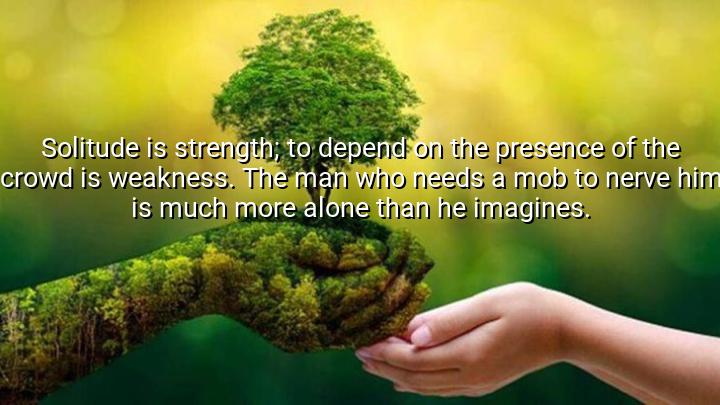




The quote "Solitude is strength; to depend on the presence of the crowd is weakness. The man who needs a mob to nerve him is much more alone than he imagines" by Paul Brunton emphasizes the power of independence and self-reliance in achieving true strength. Brunton suggests that solitude, often viewed as isolation, can actually be a source of inner strength and clarity. On the other hand, depending on the crowd or seeking validation from others is a form of weakness, as it signifies an inability to find confidence within oneself. The quote underscores the idea that true strength comes from being comfortable and confident in solitude, without needing external support or affirmation.
Paul Brunton, an English philosopher and mystic, was known for his writings on spirituality, meditation, and self-realization. His teachings emphasized the importance of looking within and finding personal empowerment through inner peace, rather than relying on external circumstances or the approval of others. This quote aligns with his philosophical views, highlighting the importance of self-sufficiency and mental resilience in the pursuit of personal growth and enlightenment.
The phrase "the man who needs a mob to nerve him is much more alone than he imagines" highlights a paradox: even though a person might be surrounded by a crowd or seek reassurance from others, they can still feel profoundly lonely or disconnected. The need for external validation or the presence of others to feel confident can signal a lack of inner peace and self-worth. In this sense, the person who relies on the crowd for support is more emotionally isolated than someone who can stand alone with strength and confidence.
Ultimately, Brunton’s quote encourages self-discovery and independence as the foundation of personal strength. It challenges the notion that community and external validation are essential for emotional well-being, suggesting instead that solitude offers a chance for true empowerment. By learning to trust and strengthen oneself in moments of solitude, one can cultivate a deeper, more authentic connection to their own strength and purpose.

TNPhạm trung nguyen
I appreciate the sentiment, but is solitude really a universal strength—or does its value depend on context and personality? Some thrive in introspection; others may crumble without external connection. I wonder if Brunton’s idea applies more to spiritual or philosophical selfhood than everyday social interaction. Still, it's a compelling reminder that if we can't find peace alone, the crowd won't really help us either.
PNPhuongUyenn NguyenDang
This quote makes me think of how often people chase crowds or followers to feel significant. It's kind of haunting to imagine someone surrounded by noise yet still deeply alone. Is Brunton warning us that external validation is a trap? If so, how do we cultivate that inner strength he’s advocating for without completely withdrawing from society? Especially now, when digital presence feels almost mandatory.
LVCharlie Bach Luu Viet
Does this perspective undervalue the role of collective energy in human progress? I mean, some of the most powerful movements—civil rights, social change, even artistic revolutions—have been built by communities, not lone individuals. While personal strength is admirable, is it realistic to imply that needing others is always a form of weakness? Maybe there's a balance Brunton doesn't fully acknowledge here.
TLHo Tung Lam
I find this quote powerful and a bit intimidating. It seems to elevate solitude to a form of higher strength—but what does that mean for those who fear being alone? Is it weakness to crave connection or validation? Or is Brunton talking about a different kind of solitude, one that's more about internal self-reliance than physical isolation? I'd love to explore how we distinguish between solitude and emotional avoidance.
GHCao Nguyen Gia Hy
Is Brunton suggesting that true independence is only possible in solitude? I get the idea that relying too heavily on others can make you weaker, but isn’t there also strength in interdependence? This quote feels a bit absolute. What about people who draw healthy energy and support from community? Can’t there be courage in admitting we need others sometimes, especially in an age where isolation can be so harmful?