

Self-government does not and should not imply the use of political agencies alone. Progress is born of cooperation in the community - not from governmental restraints.
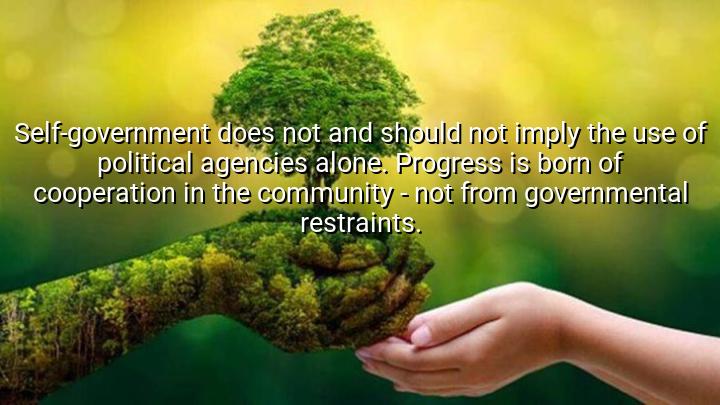




The quote, "Self-government does not and should not imply the use of political agencies alone. Progress is born of cooperation in the community - not from governmental restraints," is attributed to Herbert Hoover, the 31st President of the United States. In this statement, Hoover emphasizes the importance of community-driven efforts and collaboration over reliance on governmental control or intervention. His perspective reflects a belief in individual liberty and the power of grassroots cooperation in achieving societal progress.
Hoover's quote suggests that self-government goes beyond the influence of formal political structures. Rather than seeing the role of the government as the primary agent of change, he argues that society flourishes through mutual support and collaboration among individuals and communities. This idea challenges the notion that government action or regulations are the sole means of advancing society, advocating instead for a more decentralized approach.
The quote also critiques governmental restraints, implying that excessive government control can stifle the natural innovation and cooperation that occur in a free society. Hoover champions the idea that progress emerges from a shared effort within communities, where people come together to solve problems and improve their lives without heavy-handed governmental involvement.
Ultimately, Hoover's perspective reflects his broader political philosophy that values voluntary cooperation and community initiative over central authority. By placing the responsibility for societal growth on individuals working together, he underscores the belief that true advancement comes from the bottom up, driven by the collective efforts of a free and cooperative populace.

DCduy07 Chuanh
This idea makes me think about contemporary movements like cooperative businesses, local councils, and participatory democracy. How successful have these been in promoting progress outside traditional political frameworks? What challenges do they face, and what lessons can be learned from their experiences? Could Herbert Hoover’s vision guide future reforms in governance and civic engagement?
MHHA LE MINH HUNG
Emotionally, this quote evokes a sense of empowerment, suggesting that progress is within the reach of ordinary people working together. But it also raises concerns about inequality and power imbalances within communities. How can self-government ensure inclusivity and fairness without relying on formal political mechanisms? What safeguards are necessary to prevent abuses in a system driven primarily by community cooperation?
NQNga Quynh
Reading this, I’m curious about the role of governmental restraints mentioned here. Are they seen as obstacles to progress, or can they sometimes facilitate it by providing order and protection? How do different political systems interpret the relationship between self-government and governmental control? Can a balance be struck that encourages both community cooperation and effective governance?
HOHa Oanh
I appreciate the emphasis on cooperation within communities as a driver of progress. What are some practical ways individuals and groups can foster this cooperation without waiting for government directives? Does this imply a more decentralized or libertarian approach to governance? How might this philosophy apply to issues like environmental sustainability or social justice where collective action is crucial?
HDtrinh hai dong
This quote makes me question the balance between government intervention and grassroots cooperation. How much should self-government depend on political institutions versus voluntary community action? Can progress be sustained if government involvement is minimized, or do political agencies provide necessary structure and resources? How do modern societies navigate this tension between formal governance and community-led initiatives?