

Recommend virtue to your children; it alone, not money, can make them happy. I speak from experience.
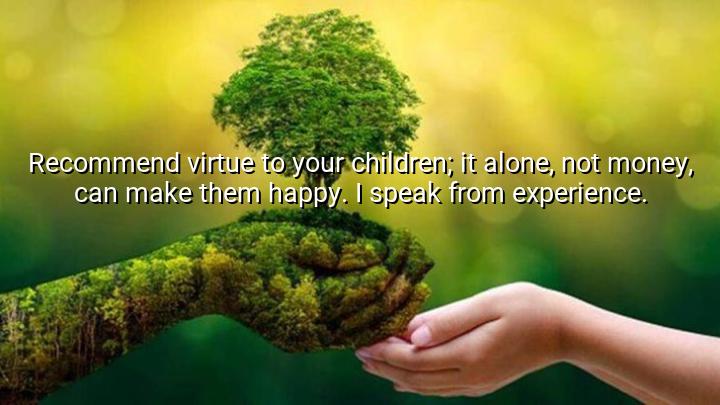




The quote "Recommend virtue to your children; it alone, not money, can make them happy. I speak from experience." by Ludwig van Beethoven reflects the composer's deep belief in the importance of moral integrity over material wealth. Beethoven, one of the most influential composers in history, recognized that true happiness and fulfillment come from virtuous living—values such as honesty, kindness, and resilience—rather than the pursuit of money or worldly possessions.
Beethoven, who faced many personal challenges including deafness and financial struggles, was a man who experienced the tension between material success and personal well-being. His own life was a testament to the idea that wealth did not guarantee happiness. Despite his musical fame and financial instability at times, Beethoven valued inner peace and moral character far more than monetary success.
The quote also speaks to the responsibility of parents to guide their children in the right direction. Recommending virtue to the next generation implies that parents should emphasize moral education over materialism, encouraging children to develop character and personal values that will lead to lasting contentment. Beethoven’s message is that money can provide temporary satisfaction but cannot sustain true happiness.
Drawing from his own life, Beethoven's words carry weight, especially considering the difficult circumstances he faced. By speaking from experience, he emphasizes that no matter how much material wealth one may accumulate, it is virtue, inner strength, and moral integrity that ultimately provide the foundation for a meaningful and happy life.

GDGold D.dragon
This makes me reflect on how society defines success for children. Is it better to raise a morally grounded child who may struggle financially or one who is materially successful but ethically ambiguous? Is there a balance, or must one always outweigh the other? I feel torn between admiration for the sentiment and the harsh reality of the world we live in.
TKDinh thai Khang
Beethoven’s statement feels noble, but I have to ask—how would this advice be received by someone living paycheck to paycheck? For many, money isn’t about luxury but survival. Is it fair to suggest that virtue alone can bring happiness when basic needs aren’t met? I’d love to hear a perspective on how this quote aligns—or conflicts—with Maslow's hierarchy of needs.
NAThu Tran Ngoc Anh
This quote makes me think: can virtue be taught at all, or is it mostly modeled through behavior? If parents themselves aren't virtuous, can they realistically instill those values in their children? And if not, does that mean virtue is more of an inherited character trait than something consciously passed down? I'm curious what others think about the teachability of ethics and morality.
Ppikachu
I'm struck by the emotional weight behind Beethoven's words. Clearly, he experienced deep hardship or perhaps observed enough to form this belief. But it makes me curious—what personal pain or family experience drove him to prioritize virtue over wealth? Is this a universal truth, or more reflective of his own unique struggles as an artist living on the edge of poverty?
NL46-Thao Vy Nguyen Lo
Is virtue truly enough in today's complex world? While I admire Beethoven's conviction, I wonder how practical this idea is in a modern society where financial security often determines access to healthcare, education, and even opportunities for moral development. Can we really separate happiness from material stability, or is this perspective more idealistic than actionable for most parents today?