

Polka dots can't stay alone. When we obliterate nature and our bodies with polka dots, we become part of the unity of our environments.
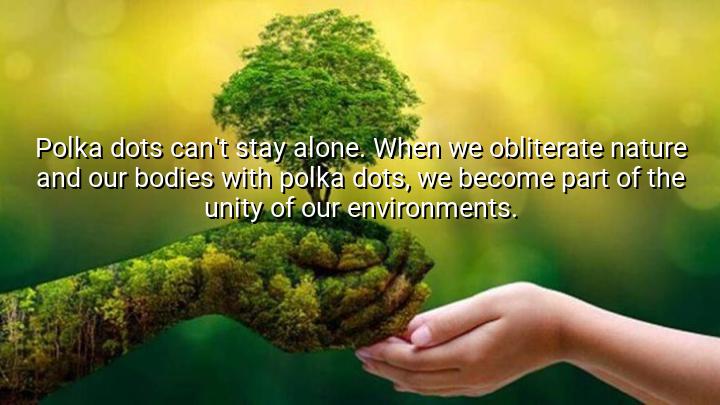




In this quote, Yayoi Kusama, a renowned Japanese artist, reflects on her iconic use of polka dots in her art and how they serve to connect individuals with their surroundings. She suggests that polka dots can't stay alone, meaning that when used in art or design, the dots cannot be isolated—they are always part of a larger, interconnected whole. Kusama’s polka dots symbolize a way of obliterating nature and individual identity, merging with the environment in a way that blurs the line between the self and the world around us.
Kusama’s use of polka dots serves to disrupt the boundaries between the human body, art, and the environment, creating a sense of unity. By covering surfaces with polka dots, whether in her installations, sculptures, or clothing designs, she transforms the viewer and their surroundings into one continuous, immersive experience. The repetition of dots visually and symbolically removes distinctions, suggesting that individuals are not separate from the world, but rather part of an expansive, interconnected reality.
The phrase "obliterate nature and our bodies with polka dots" reflects Kusama's philosophy of breaking down the boundaries of personal identity and nature. Her art often explores themes of infinity and the interconnection of all things, challenging the notion of separateness and encouraging a holistic view of existence. The dots represent an immersive experience that envelops both the viewer and their environment, reinforcing the idea that we are deeply connected to the world around us.
Ultimately, Kusama’s quote reflects her belief in unity and the interconnectedness of everything in life. By using polka dots to dissolve boundaries, she invites people to experience the world as a fluid, continuous whole, where the distinctions between individual and environment become less significant. The dots, therefore, represent both a visual and conceptual bridge that unites people with their surroundings, urging a deeper connection to the world.

UGUser Google
I wonder if this quote reflects Kusama’s personal experience with mental illness. Her work often plays with repetition and obliteration in a way that feels both meditative and overwhelming. Could the polka dots represent a coping mechanism—an attempt to impose order, or perhaps lose oneself in something larger? It’s beautiful but also haunting. Can becoming part of the environment be healing, or might it also be a form of escape?
Llequangdai
As someone who’s struggled with feeling separate from the world around me, this quote struck a nerve. Is Kusama offering a cure for disconnection through art and symbolism? It feels like she’s saying there’s a kind of peace in surrendering to the larger pattern of life. But can everyone experience that, or is it a mindset only accessible through intense personal or creative transformation?
HNMinh Hoang Nguyen
This quote reminds me of how artists often express what philosophers struggle to put into words. Kusama seems to see the self as something fluid—capable of merging with space, with nature, even with patterns. It makes me think: what does it mean to ‘become part of the unity of our environments’? Is this about artistic immersion, spiritual transcendence, or mental health? Her words are mesmerizing, but also cryptic.
T9Do Thi Thanh Thao 9b_17
Kusama’s view feels both playful and profound. The idea that polka dots can’t exist in isolation makes me think about community and the way every element in nature is connected. But I’m curious—does she see this as a literal truth, a symbolic statement, or something spiritual? Her work blurs those lines. Is the polka dot a stand-in for the soul, atoms, or just a whimsical way to discuss oneness?
MLNguyen Thi Mai Linh
I’m both intrigued and a little unsettled by this. Kusama seems to be equating pattern with identity, and erasure with unity. Is she saying that individuality is inherently separate from nature, and must be undone for true harmony? That’s a bold, even radical thought. But in a world where people are trying to assert their uniqueness, is blending into our environment a liberation—or a loss?